One unpowered night sets the standard
Lockhouse 25 is atmospheric, balanced and powerless. Two shorter days do not equal two charging opportunities.
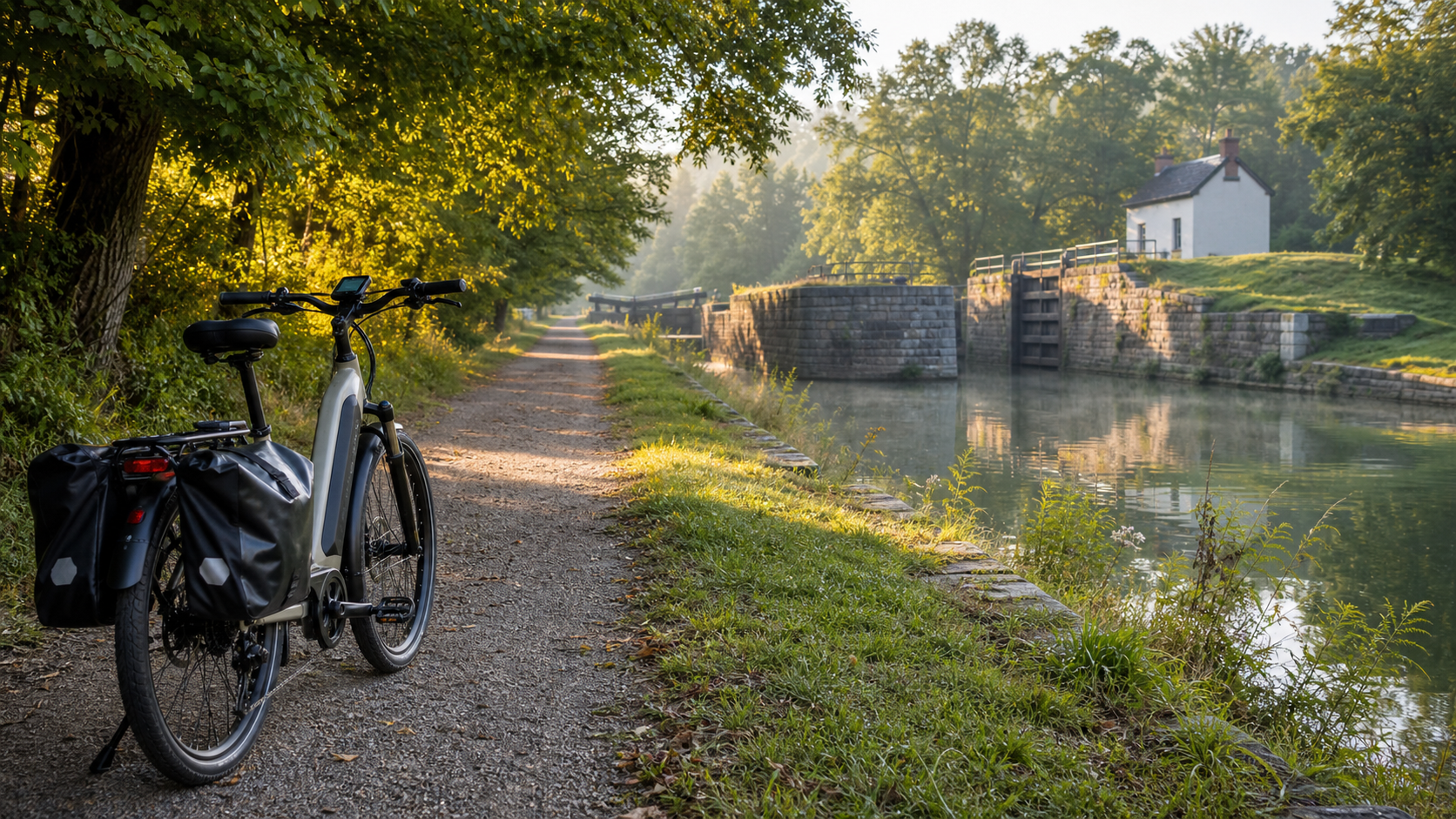
Georgetown → Cumberland · Westbound
A balanced 184.5-mile e-bike journey with short days, deep canal history and one rustic night that changes the battery math.
The Chesapeake & Ohio Canal Towpath runs 184.5 miles from Georgetown in Washington, DC, to Canal Place in Cumberland, Maryland. Six days moves the ride out of endurance territory: most stages land near 30 miles, leaving time for locks, aqueducts, towns and a slower surface after rain.
The elegant stage split uses historic Lockhouse 25 at Edwards Ferry for night one. That choice comes with a hard fact: the rustic lockhouse has no electricity, HVAC or indoor plumbing. Riders must either prove enough usable battery for the first 60.7 miles with a 20% reserve, or replace that night with a powered room and a fully arranged transfer. The rest of the plan uses powered town lodging.
Lockhouse 25 is atmospheric, balanced and powerless. Two shorter days do not equal two charging opportunities.
Wet limestone, roots, puddles and soft resurfacing can raise watt-hours per mile even when daily distance is modest.
Confirm a room, secure bike location, outlet and explicit battery-charging permission before treating an overnight as powered.
The six-day rule
More time does not create more outlets.
This is a dated snapshot, not a departure forecast. Open the official conditions page 72 hours before the ride, the evening before and each morning on the trail.
The towpath is through-ridable, but the temporary bridge stairs closed July 27. The NPS shuttle operates 9:00 a.m.–6:30 p.m., weather permitting. It has no bike rack; one or two bikes may ride inside only at the driver's discretion.
Read the NPS project notice ↗Dam No. 5 currently uses a short mulch path and wooden stairway. Polly Pond sends riders onto roughly two miles of the Western Maryland Rail Trail, where only Class 1 e-bikes are allowed.
Open current C&O conditions ↗The 3,118-foot tunnel is open, dark, damp and sharply cooler than the trail. NPS directs cyclists to dismount in the tunnel and on boardwalks. Carry a headlamp even for a daylight arrival.
Read the tunnel guidance ↗E-bike access
NPS defines an e-bike here as a two- or three-wheeled cycle with fully operable pedals and an electric motor of less than 750 watts.
Read the NPS bicycle rules ↗Away from public motor roads, the motor may not move the bike without pedaling. The maximum speed on designated park routes is 15 mph.
Verify the operating rule ↗The optional Western Maryland Rail Trail—and the current Polly Pond detour using it—permits only Class 1 e-bikes. A throttle-equipped bike does not become Class 1 merely because the throttle is unused.
Check the WMRT note ↗The route line uses the C&O portion of a public Ride with GPS Ambassador route and is rendered over OpenStreetMap. It shows the corridor and overnight pattern—not current detours or turn-by-turn navigation.
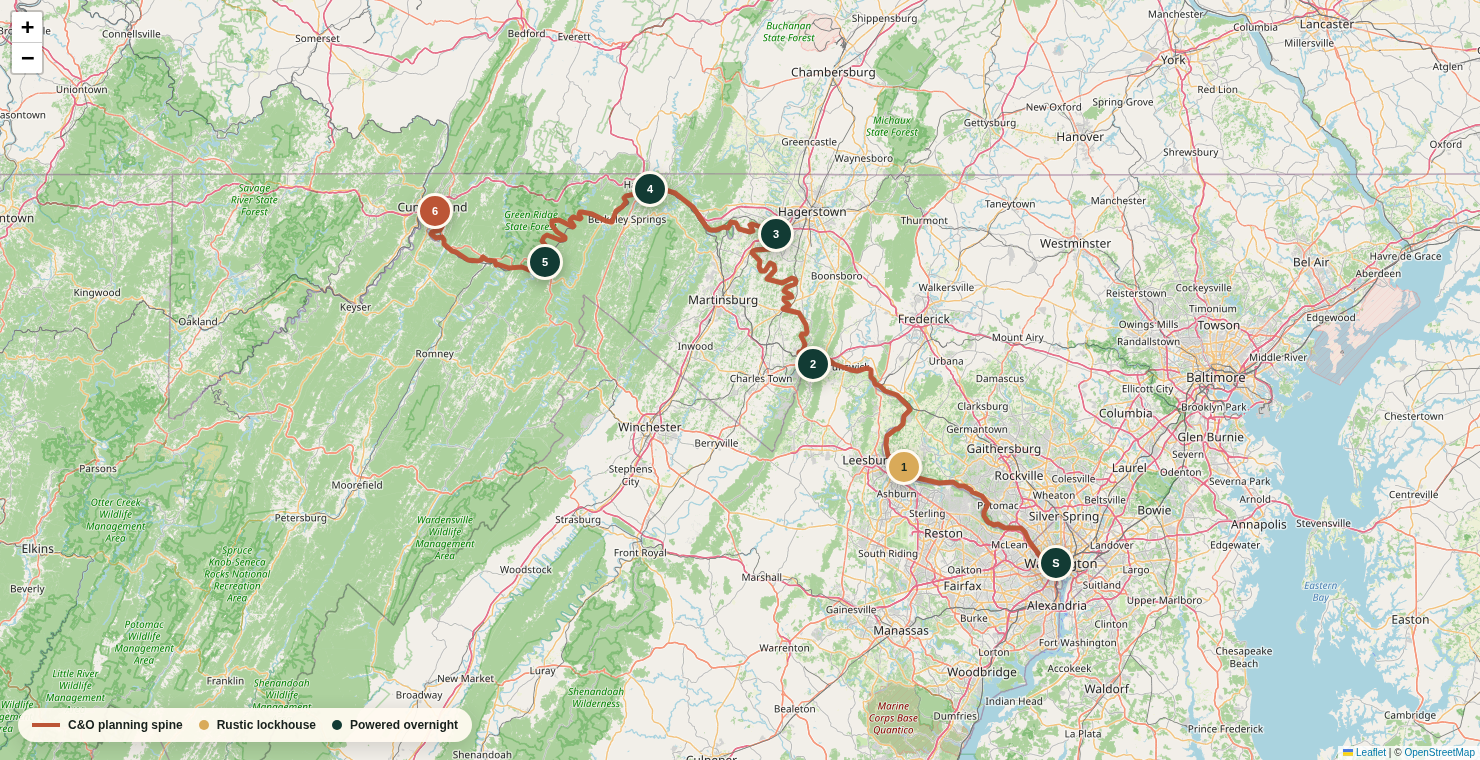
Navigation gate: carry a current offline route, NPS maps and current detours. Do not navigate from this page alone.
Open the underlying public route ↗Days from mile zero to mile 184.5
The stage miles total exactly 184.5. Battery figures are conservative planning ranges for a loaded e-bike on mixed towpath, not manufacturer claims. Test your own bike under touring load.
C&O Canal Towpath
Reserve the historic lockhouse directly through Canal Quarters. It is rustic: no electricity, HVAC or indoor plumbing.
Rustic · no powerThe urban canal edge gives way to Great Falls, wooded towpath and the long Potomac bends toward Edwards Ferry. Mostly level hardpack with roots, puddles and slower surface after rain.
Highlights: Georgetown mile zero, Great Falls, Seneca Creek Aqueduct and an overnight inside a restored lockkeeper's house.
Power: Budget 400–600 Wh and finish with enough battery to cover day two plus a 20% system reserve. Do not start this version without a loaded 61-mile range test.
Food + water: Carry dinner, breakfast, trail food and sufficient treated water. The nearest pump identified by Canal Quarters is about 0.3 mile away at Chisel Branch and is non-potable.
Charge: None. The lockhouse has no electricity. A spare battery is useful only if its combined system has already passed the loaded two-day test.
Gate: Lockhouse 25 is first-come by advance reservation and not a casual walk-in. If it is unavailable—or your bike cannot prove the required range—use a powered-room transfer arranged before departure and return to the exact route point before day two.
C&O Canal Towpath
Powered hotel, inn or B&B only after confirming loaded-bike access, controlled storage and charging permission.
Powered roomA short day through White's Ferry, Monocacy Aqueduct and Point of Rocks, ending beneath the cliffs and railroad bridges of Harpers Ferry.
Highlights: Monocacy Aqueduct, Point of Rocks, river views and the approach to Harpers Ferry at mile 60.7.
Power: Budget 400–600 Wh from the battery remaining after day one. The overnight room is the first full electrical reset since Georgetown.
Food + water: Carry breakfast and a full morning supply; use town services at Point of Rocks or Harpers Ferry only after checking hours. Refill with municipal water.
Charge: Cool and dry the pack, inspect it, then use only the approved charger in a location and on a schedule accepted by the property.
Gate: The current Harpers Ferry shuttle has no bike rack and takes bicycles only at the driver's discretion. Confirm a bike-capable town-access plan; if it fails, keep riding on the towpath to a prearranged alternative rather than forcing a loaded bike onto unsafe stairs or roads.
C&O Canal Towpath
Powered room near Williamsport with a confirmed route from the towpath and secure storage for the loaded bike.
Powered roomHistoric locks and river bends lead through Antietam country, Shepherdstown access and the spectacular concrete shelf at Big Slackwater.
Highlights: Antietam area, Shepherdstown river crossing, Big Slackwater and the restored Conococheague Aqueduct.
Power: Budget 500–750 Wh. Start full and preserve 20% for soft trail, headwind or a longer-than-expected lodging transfer.
Food + water: Carry lunch and two full bottles. Shepherdstown access is an optional service detour; Williamsport is the dependable end-of-day food and municipal-water reset.
Charge: The room is the plan. Any midday outlet is a bonus only after asking permission and confirming a safe, dry charging location.
Gate: High Potomac water can close Big Slackwater and activate a narrow local-road detour. Check the live conditions page before leaving and obey closure signs on site.
C&O Canal Towpath
Trail-accessible motel, inn or B&B with controlled bike storage and explicit permission to charge overnight.
Powered roomThe shortest stage follows locks, dams and wooded river corridor through the narrow Maryland panhandle. It is the trip's natural recovery day.
Highlights: Conococheague Aqueduct, Dam No. 5 country, canal engineering and a walkable finish in Hancock.
Power: Budget 300–500 Wh. Keep the usual reserve even on a short day; the signed detour and surface can add handling work.
Food + water: Eat before leaving Williamsport, carry lunch and refill with municipal water in Hancock. Treat any hiker-biker well water.
Charge: Use the room for a full reset and charge phones, lights and power banks at the same time—without overloading a circuit or improvising outdoor cords.
Gate: Dam No. 5 currently uses a short mulch path and wooden stairs. Loaded e-bikes may require a two-person carry; inspect the feature before committing your footing.
C&O Canal Towpath
Reserve a powered room or cabin in the Paw Paw area and confirm the outlet, meal plan and exact transfer from the towpath.
Powered stay · verifyThe canal grows quieter beyond Hancock, with long wooded reaches, the Little Orleans service window and a final walk through Paw Paw Tunnel before the overnight transfer.
Highlights: Western Maryland Rail Trail views, Little Orleans, Fifteenmile Creek, Paw Paw Tunnel and its dramatic rock cut.
Power: Budget 450–700 Wh. Start full and hold reserve for a lodging transfer or soft surface. Do not assume a campground supplies an e-bike outlet.
Food + water: Carry a complete trail lunch and emergency dinner. Little Orleans is the logical service stop, but hours are not guaranteed; hiker-biker wells remain non-potable.
Charge: Treat the night as powered only after direct confirmation. Ask whether the battery may be charged indoors, whether it must be removed and where the bike will be secured.
Gate: The Polly Pond detour uses the Class 1-only WMRT. Near the finish, dismount and walk through Paw Paw Tunnel and on its boardwalks with a headlamp. Riders with a non-Class-1 configuration must confirm a legal detour route with NPS before departure.
C&O Canal Towpath
Finish at Canal Place, then use a downtown room, confirmed pickup or return reservation already matched to the exact e-bike.
TerminusA compact final stage leaves Paw Paw for the remote mountain corridor, then follows the Potomac and canal ruins toward the western terminus.
Highlights: Upper Potomac solitude, Oldtown, South Branch country, wooded canal ruins and mile 184.5 at Canal Place.
Power: Budget 400–650 Wh and retain reserve for soft trail, a headwind or a post-finish transfer.
Food + water: Start with breakfast and a full trail supply. Services are limited until Cumberland; carry enough to finish without an open store.
Charge: Leave Paw Paw full. The finish room or pickup vehicle is the primary charging and battery-handling plan.
Gate: Services remain limited until Cumberland. Leave Paw Paw only with a finish-day food, water, daylight and pickup plan that does not depend on an open store along the towpath.
The six-day route works because Lockhouse 25 balances the lower canal. It is optional. The trip is safer when the lodging changes to fit proven range—not when the range estimate changes to fit the lodging.
Use this version only with a confirmed reservation, non-potable-water treatment, rustic-night gear and a battery system that has proved at least 61 loaded towpath-style miles with a 20% reserve.
Arrange a bike-capable pickup at Edwards Ferry, charge overnight in a confirmed room and return to the same towpath point the next morning. Price and reserve the transfer before day one.
Do not improvise rural-road mileage after dark or assume a private outlet is available.
Skip the lockhouse and use powered canal-town lodging, accepting a longer first or second day. Recalculate every stage and rebook the chain rather than mixing two itineraries on the trail.
The separate three-day guide remains available for riders who prefer long hotel-to-hotel stages.
The relevant number is your own loaded watt-hours per mile on damp gravel. Six days lowers daily consumption, but the rustic first night makes proven two-day capacity the admission ticket.
Two-day field gate
Example: 1,200 usable Wh ÷ 15 Wh/mi
80 theoretical miles → 64 miles after a 20% reserveRide 61 loaded gravel miles across two consecutive days without charging. Use the same assist level, tires and touring weight.
Plan from the higher watt-hours-per-mile result in wind, wet surface or cool weather—not the best ride.
Reserve covers mud, a missed entrance, detour, headwind or a battery with less capacity than its label.
Use an approved charger on a stable surface and only with the overnight property's permission.
NPS says it does not offer charging locations along the towpath. Lockhouse 25 has no electricity. Every later outlet is a private arrangement and must be confirmed directly.
This is a mixed-lodging ride: one rustic lockhouse followed by town rooms. Carry what solves towpath failures, an unpowered night and non-potable water without turning the bike into a freight train.
System 01
Build for wet limestone, roots and a heavy rear wheel.
System 02
Build the first two days as one electrical stage.
System 03
Lockhouse 25 supplies history, not hotel services.
System 04
Every day ends at a door or pickup already understood.
Decide the return before reserving the five-night chain. A loaded touring e-bike often fits a bicycle shuttle more easily than Amtrak's published limits.
Commercial operators advertise C&O service for riders, bikes and gear. Confirm the exact Cumberland pickup, DC drop-off, bike length, tire width, loaded weight, battery handling and whether panniers stay attached.
Shepherdstown Pedal & Paddle ↗ · C&O Bicycle ↗ · Wheelzup Adventures ↗
The current Floridian links Cumberland and Washington, and Amtrak lists trainside bicycle service with advance reservations. Its published e-bike limit is 50 pounds, standard dimensions and tires no wider than 2 inches. The bike and battery must have qualifying laboratory certification, and the passenger must handle the bike without assistance.
Cumberland is an unstaffed station with no checked baggage, bike boxes or baggage assistance. Confirm that bicycle space is offered on the exact Cumberland–Washington departure before relying on the train.
Floridian route ↗ · Current timetable ↗ · E-bike rules ↗ · Cumberland station ↗
If one answer is no, repair the plan rather than the expectation.
Confirm motor rating, pedal-required operation and Class 1 status for the active WMRT detour.
Use two consecutive loaded gravel days and finish with at least 20% reserve. Pavement estimates do not count.
Carry access instructions, food, linens, lighting and a non-potable-water treatment plan.
Know the current NPS shuttle window and a through-riding alternative before leaving Edwards Ferry.
Get direct confirmation of secure storage, outlet location and charging permission, especially at Paw Paw.
Review NPS conditions 72 hours before departure and each morning; save the page and route offline.
Practice removing the e-bike wheel, fixing a flat and reinstalling it with the tools carried.
A ticket is insufficient if the bike violates weight, tire or handling limits. Confirm the exact bike acceptance.
Primary route and rule sources: NPS bicycling and e-bike rules, current park conditions, Byron Bridge and shuttle notice, camping and water guidance, and Paw Paw Tunnel guidance.
Lockhouse planning: the C&O Canal Trust's Canal Quarters program, amenities, water and bicycle-storage FAQ, and Lockhouse 25 page. The Trust identifies Lockhouse 25 at mile 30.9 as rustic and without electricity, HVAC or indoor plumbing.
Planning context: the Trust's C&O biking guide and town explorer. The route overview uses the C&O portion of Ride with GPS Ambassador Route 14293085 over OpenStreetMap.
Return planning: Amtrak Floridian, the current official timetable, Amtrak special-item limits, and the Cumberland station page.
Freshness: official conditions and operating policies checked August 1, 2026. Mileage splits, battery use, travel times and the powered-room fallback are planning estimates. This is an editorial planning aid—not a reservation, purchased route, safety guarantee or substitute for current NPS instructions and direct lodging confirmation.