INTRODUCTION
What this history claims
Abstract
This history reaches farther than a list of names, but not as far as inherited family trees often claim. The surviving records establish a substantial American family structure across Virginia, West Virginia, Ohio, Indiana, Michigan, South Carolina, and Arkansas. They prove several parent-child links directly. They support other links through strong, converging evidence. They also expose places where a familiar surname, a plausible migration, or a copied online pedigree has been mistaken for identity.
The central finding is simple: the American record is strongest where families left several kinds of evidence at once. A marriage entry, a census household, a child's birth record, a will, and a newspaper notice can reinforce one another. The chain becomes fragile when one record must carry a conclusion it was never designed to carry. A census before 1880 can place people in one household without calling them parents and children. A death certificate can name parents decades after childhood, but the informant may be wrong. A pension deposition can describe a migration and a sibling group while still failing to identify which same-named man belonged to the direct line.
The Staley line supplies the deepest and most difficult example. Daniel Lawrence Staley is connected to Stephen Staley and Ann H. Gardner by an unusual pair of Wayne County birth-register entries. One register names Daniel and his father. The other records a conflicting child name on the same birth date but supplies the mother, Anna H. Staley. The conflict does not disappear. It becomes part of the proof: the two entries, read with the household sequence, establish the family more responsibly than either entry could alone. Stephen and Ann's movement from Ohio to West Virginia and then toward Arkansas is supported by marriage, census, newspaper, cemetery, and obituary evidence. Earlier, Jacob Staley's 1793 Berkeley County will directly names a son Stephen. Between those anchors lies a strong but not direct Wayne County heir-and-partition argument. Beyond Jacob, records from York County, Pennsylvania, now separate several same-named men and point to a Jacob and Catharina in Hellam and York Townships as the most likely Pennsylvania household. That identification is a working hypothesis, not proof. In the twentieth century the line runs from Arkansas, including a 1940 address at the Dyess farm colony, to Marshall and Albion in Calhoun County, Michigan.
The European work produced genuine original-record findings, but not the transatlantic bridge that public trees imply. A 1732 Stähli baptism entry at Gundershoffen is dated 20 January, correcting a long-repeated 30 January variant. The 1709 Gundershoffen entry names a child Jacob, not Hans Jacob or Johann Jacob, and does not give his mother's maiden surname. At Meiringen, Melcher Stäli married Madle Stydler on 15 February 1672, and their son Hans was baptized on 9 June 1673. The register does not call that child Johann Jakob. These are real people and real events. The records do not yet prove that they form the claimed chain to Jacob Staley of Berkeley County.
The Konkle line is comparatively stable through Floyd, Edwin, Simon, and Cornelia. Simon's 1905 death record identifies Christian G. Konkle and Mary as his parents, but the relationship is not proof-closed because a lifetime or near-lifetime source has not corroborated it and Simon appears in the Wildman household in 1850. The Cash line is proved through John W. Cash as Henry Cash's son, while Henry's placement with Sidney or Cidey and Mary remains a working hypothesis because the 1850 and 1860 censuses do not state relationships. The Turnes line is proved through Wirt or Wert Turnes to Henry and Louisa and directly identifies Aaron as Henry's parent. Pleasant Turnes's marriage record strengthens Mary as the likely mother within the household cluster, but it does not directly name her as Henry's mother.
This paper therefore presents a family history with visible proof horizons. It treats a limit as a finding, not an embarrassment. The purpose of the standard is not to make the family smaller. It is to keep each life attached to the evidence that actually belongs to it.
The claim that governs this history
Genealogy becomes most persuasive at the exact point where it refuses to pretend. A record may prove an event, identify a relationship, support an inference, expose a conflict, or show that a search route has gone cold. Those are different results. They should sound different on the page.
This paper uses seven proof labels. Proved means that a direct record states the relationship or that independent records converge so tightly that no reasonable competing identity remains. Strong indirect evidence means that several facts fit one relationship, but the record set still lacks a direct statement. Identified but not closed means that one direct source names the relationship, while the source's distance from the event or an unresolved conflict requires corroboration. Working hypothesis means that the proposed relationship is plausible and research-worthy but should not be placed in a fact narrative. Conflict marks two or more pieces of evidence that cannot yet be harmonized. Negative control marks a source that helps keep the wrong person or family out of the line. Open boundary names the place where the current evidence stops.
These labels are not grades assigned to ancestors. They describe the condition of the evidence. A person does not become less real because a courthouse burned, a clerk omitted a relationship, or a register survives only in difficult handwriting. Nor does a confident online tree make a relationship more real. The label belongs to the proof, not the life.
The evidence also has a hierarchy, but no single record type wins every argument. A will that says “my son” usually carries direct relationship evidence. A census relationship column can do the same after the federal schedules began recording relationships to the head of household. Earlier censuses can show co-residence but not kinship. A marriage record may name parents, or it may only prove the marriage. A death record can preserve parent names that exist nowhere else, yet the informant often spoke many decades after the birth. Newspapers can fix a family in a place, connect an event to a social network, or reveal a migration. They can also repeat rumor. Compiled trees are useful maps to possible sources. They are not the sources they point toward.
The method used here is correlation. Names, ages, spouses, children, places, occupations, property, informants, and chronology are tested together. Variant spellings are accepted only when the surrounding identity remains stable. Stephen Staley can appear as Story or Storey because the same wife, children, ages, and Wayne County setting hold the household together. Simon Konkle can appear as Conkle or Kenkel when the parent fields and household sequence agree. Wirt can appear as Wert, and Turnes as Turns or Turner, when spouse, parents, date, and place converge. The surname alone never carries the merge.
The method also asks what a record does not say. The 1850 census does not say that every child-shaped person in a household was a son or daughter. The 1891 notice that Stephen Staley's family went west does not name Arkansas. A military roster does not prove kinship between two soldiers. The Gundershoffen register does not contain a hidden “Hans” merely because a later profile uses the compound name Hans Jacob. Absence of a word can be consequential when the claim depends on that word.
Finally, the work keeps the direct line separate from the social field around it. Brothers, in-laws, neighbors, sureties, witnesses, co-heirs, church members, and soldiers in the same company often explain how a family moved and whom it trusted. This is sometimes called family, associates, and neighbors research. The principle is older than the acronym: people leave records in groups. Yet a group is not a pedigree. Collateral evidence can identify the right household or disprove the wrong one. It cannot be made to say “parent” when it says only “neighbor,” “brother,” “surety,” or “co-party.”
The result is a history with different degrees of resolution. Some sections read like a settled narrative. Others read like the edge of a map. Both belong here because both describe what the records will bear.
A reader's map of the findings
The Staley line has three different evidentiary zones. From Daniel Lawrence Staley back through Stephen and Ann, the family is proof-ready by correlation. The records contain a real conflict at Daniel's birth, but the conflict is bounded and explained. From Stephen S. back to the older Stephen and Mary, the evidence is strong and indirect. The household placement, later identity, and Wayne County estate network converge, while a direct “son” or heir-basis statement remains missing. At Jacob of Berkeley, the evidence becomes direct again because his will names a son Stephen. Beyond Jacob, the proof status falls to working hypothesis. The York County History Center records delivered in October 2026 showed that the Jacob married to Elizabeth was a son of Peter Staley of Chanceford, not the Berkeley testator, and they point instead to a Jacob and Catharina who baptized children in Hellam and York Townships in the 1760s.
The pension files sharpened that picture. W6194 gives Peter's own residence history and Daniel's statement that Peter was his brother. W6179 preserves Daniel's description of a father Jacob and brothers Jacob and Peter who came from York County, and it shows that Barbara, once read as a rival to Catharine, was the wife of Jacob Jr. Read with the 1793 will, the two files make a strong indirect case that the testator's family came from York County before 1781. They still do not say which York County household it was.
The late collateral work also changed the texture of the Staley story. The 1853 newspaper notice independently confirmed Stephen and Ann's marriage in the language of their community. The 1891 Ceredo notice caught the family in motion. The 1906 Arkansas material and cemetery controls established the endpoint. Wayne County obituaries, reunion items, marriage records, and death certificates mapped siblings and associates while exposing same-name hazards. This work did not transform an indirect parentage link into a direct one. It made the family around that link more visible and the remaining source target more exact.
The European record work produced the clearest revision to inherited names. The Meiringen register does not record Johann Jakob in 1673. It records Hans. The Gundershoffen register in 1709 does not independently record Hans Jacob. It records Jacob. The 1732 date is the twentieth. These findings do not disprove every possibility behind the compound names. They do remove the original registers as simple proof of those forms. A future argument must now explain the name changes instead of assuming them.
For the Konkle line, the proof is strongest from Floyd through Edwin to Simon and Cornelia. Direct parent fields repeat across birth and marriage records. Census households connect childhood and adulthood. Simon's occupation as a house and carriage painter adds a credible historical detail between enumerations. The open boundary begins at Christian and Mary. Simon's death record names them, so the pair is more than a speculative tree attachment. The 1850 Wildman placement and the absence of lifetime corroboration keep the relationship from proof closure.
The Wayne County, Ohio, library search narrowed rather than solved that problem. A defined index contained no Konkle surname in its wills, estates, and guardianships for the relevant period. Tax materials showed variant-name households in the county. This combination warns against two opposite mistakes: declaring the parents proved from the death record alone, or declaring them absent because one index was negative. The next useful evidence must explain Simon's childhood placement or connect him to Christian and Mary through land, probate, court, church, or another near-contemporary record.
The Cash line is secure through Allan to John W. and then to Henry. Parent fields and relationship columns say what the proof requires. The earlier Henry-to-Sidney/Cidey-and-Mary link remains a working hypothesis. Two household placements make the hypothesis strong enough to guide research. The pre-relationship-column censuses cannot finish it. A probate or deed record may do so because the 1897 administration reference points toward an estate context.
The Turnes line is secure through Ellen, Clarence, Wirt, and Henry and Louisa. Aaron is directly named as Henry's parent. The 1850 household and Pleasant's marriage record make Mary a strong maternal candidate. Pleasant's shared military company with Henry adds adult association to childhood co-residence. Still, the direct source names Mary as Pleasant's mother, not Henry's. The distinction leaves one precise gap instead of a vague uncertainty.
Across all four lines, the findings can be reduced to five governing conclusions:
- The later American generations are substantially documented. Vital records, censuses, wills, and marriage registers carry most of the nineteenth- and twentieth-century relationships with direct or tightly correlated evidence.
- The hardest American gaps occur where records name groups but not relationships. Wayne partition parties, pre-1880 census households, and collateral clusters create strong arguments while withholding the decisive word.
- Same-name control is not optional. The wrong Civil War Stephen, several York Jacobs, a separate Henry Cash, and overlapping Staley spouse clusters show how quickly a plausible record can enter the wrong life.
- Original European registers corrected the tree without completing it. They fixed dates and recorded names, but they supplied no York-to-Berkeley or transatlantic identity bridge.
- Every open boundary now has a source-shaped target. The next step is not more volume. It is a relationship-bearing court paper, deed, probate file, church record, or paleographic reading capable of deciding the specific question.
This map lets a reader enter the paper without flattening its conclusions. “Proved” appears where a relationship field, will, or compelling correlation supports it. “Open” appears where the evidence genuinely ends. The historical narrative proceeds through both.
PROLOGUE
The twentieth-century road, from Arkansas to Michigan
Where the public record begins
The Staley story told here begins with Edmond Earl Staley, the most recent ancestor whose life can be discussed in public. An Arkansas birth record names Edmond Earl Staley, born 25 November 1911 at Lake City, Craighead County, Arkansas, and gives his parents as Daniel Lawrence Staley and Nellie Novella Tiner. E55
The family's census households carry him through childhood. In 1920 Lawrence D. Staley and his wife were in Maumell, Craighead County, with an eight-year-old son Edmond E. In 1930 Daniel L. and Nellie N. Staley were in Richwoods, Jackson County, with an eighteen-year-old son Earl E. The given name moves from Edmond to Earl, the father's names change order, and the mother is indexed once as "Wellie." The ages, parents and siblings hold the household together. Edmond went by Earl for much of his life, and later records use both names. E56
Edmond married Mary Jane Jackson, born in Poinsett County, Arkansas, in 1914. Her obituary gives the wedding date as 16 October 1931. An Arkansas marriage-license image is dated 15 October 1932. Both dates are kept on file until a further record decides between them. E60
A Dyess address in 1940
On 16 October 1940, Edmon Earl Staley registered for the draft. He gave his address as R.F.D. No. 1, Dyess, Arkansas, and his employer as "Self." A March 1943 church paper reports a Dyess congregation led by "Brother Earl Staley." The name and place fit Edmond Earl, though the short notice has no second detail to confirm it. E57 E58
Dyess was not an ordinary farm town. It was a federal farm colony started in 1934 in the cotton Delta of Mississippi County, Arkansas, where relief workers cleared and drained timbered land and the government planned to settle about 500 white farm families on small homesteads they could eventually buy. It was also where the boy who became Johnny Cash grew up, on Farm No. 266. The colony was hit hard by the January 1937 Mississippi River flood, ten years after the Great Flood of 1927. E65
The family's connection to the colony is real, but its details are still open. The 1940 card proves a Dyess postal address. It does not show a numbered colony farm, a homestead purchase, or work for the large Lee Wilson plantation company next door. Family memory places the Staleys near the Cash farm. That has not been tested. In September 2026 the Historic Dyess Colony archivist reported finding housing information for two Staley households, one for D. L. and Novella Staley and one for Earl and Mary Staley. If the original records and plot numbers can be obtained, they can be checked against the colony's 1936 numbered-farm map. Until then, "near the Cash place" is family recollection. E66
The road north
The move to Michigan came in two steps. Daniel Lawrence Staley's 1972 obituary says he moved to Albion, Michigan, from Little Rock in 1945. It says he worked for Lonergan Manufacturing and then as a custodian at a firm it calls "Decker Nut Mfg. Co." until he retired, and that he belonged to the Assembly of God church. The same obituary names his parents as Stephen and Polly Ann (Gardner) Staley, which agrees with the Wayne County birth-register proof described in Part I. E61
Edmond and Mary followed a few years later. Mary's obituary says the family came to Michigan in 1949, settled in Marshall in 1950, and moved to Albion in 1962. The 1950 census independently finds Edmond E. and Mary Staley in Marshall, where Edmond ran a press in a sheet-metal plant. Family memory remembers the route a little differently, as Dyess to Albion to Marshall, with a short first stop in Albion where relatives already lived. Daniel's arrival in Albion in 1945 makes that plausible, but no dated record of an early Albion address has turned up. E59 E60
Mary later worked at Albion College, from which she retired. Edmond Earl Staley died at Albion on 16 November 1986 and is buried at Albion Memory Gardens. Mary Jane Staley died on 11 August 2014, seventeen days before her hundredth birthday, and was also buried at Albion Memory Gardens. Daniel Lawrence Staley died at Albion in April 1972, aged 90, and was buried in the same cemetery. E60 E61 E62
Two family lines in one factory town
Albion is also where two of the family lines in this history meet in the same workplace. Decker Screw Products was founded in Albion in 1927 by Victor Decker, Walter Konkle and Eric Biewend. A 1937 patent for a ball-bearing caster names Walter R. Konkle of Albion as inventor and assigns it to the company. E63
In October 1940, Floyd Konkle of the Konkle line in Part IV registered for the draft at Albion and named Decker Screw Products as his employer. Decades later, Daniel Lawrence Staley's obituary placed him at "Decker Nut Mfg. Co." as a custodian. The records put members of both families in the same company town, and possibly the same company, but they do not show that the men worked side by side or explain how the two families came to be joined. Whether Floyd was related to the founder Walter Konkle is being tested and is not claimed here. E64 E61
There are two Albions in this history. Simon Konkle, Floyd's grandfather, was a house and carriage painter in Albion, Noble County, Indiana, in the 1870s. Albion, Calhoun County, Michigan, is where his descendants and the Staleys later lived. The shared name is a coincidence, not a migration route.
The rest of this history moves backward from Daniel Lawrence Staley, through West Virginia and Virginia, to the question of where the family lived in Pennsylvania before the Revolution.
PART I
The Staley line in America
A child appears twice in the record
Daniel Lawrence Staley's birth is the best place to begin because the proof contains a contradiction. A later indexed Wayne County birth register records Daniel Lawrence Staley, born 2 November 1881. It names Stephen Staley as his father. A second register entry for the same date names a child Donald L. Staley and supplies Stephen Staley and Anna H. Staley as the parents. The records do not agree on the child's given name. They agree on the date, surname, father, county, and family context. Later records consistently identify the adult as Daniel Lawrence Staley. Read together, the pair supplies what neither entry supplies alone: the direct-line child's name and the identity of both parents. E01 E02
The responsible conclusion is not that the Donald entry should be ignored. It is that the clerk or later copying process produced a name conflict inside an otherwise coherent registration pair. A proof argument becomes stronger when it explains the discordant evidence rather than selecting the convenient half. The records establish Daniel as a child of Stephen and Ann or Anna H. Staley by correlation. The conclusion remains inspectable because the two full register pages are reproduced in the document gallery. Daniel's own obituary, published in Michigan ninety years later, names his parents as Stephen and Polly Ann (Gardner) Staley. That is a late account, but it agrees. E61
Daniel's parents had married more than 28 years earlier. Lawrence County, Ohio, marriage entry 269 records Stephen Staley and Ann H. Gardner marrying on 5 June 1853. A notice in the Spirit of the Times nine days later independently reports that Stephen Staley married “Phelinda A. H. Gardner” on the fifth. The expanded given name in the newspaper is unusual, but the date, groom, Gardner surname, and local setting match the official entry. The marriage is proved. The record does not name Stephen's parents. E03
The marriage starts a household sequence. In 1860 Stephen and Ann were in Rome Township, Lawrence County, Ohio. By 1870 they were in Ceredo, Wayne County, West Virginia. Their children, ages, and birthplaces trace a family that crossed the Ohio River rather than appearing as a new household with the same names. The 1880 enumerator wrote the surname as Story or Storey in Butler District, Wayne County. Ann and the children anchor the identity. The spelling changes; the family does not. E05 E06 E07
This sequence matters because a surname is never evidence in isolation. Staley, Stayley, Stailey, Staily, Storey, Story, Stähli, and Stehly can represent the same family in one record set and entirely different families in another. Here the variant is controlled by wife, children, place, and chronology. Later in York and Berkeley Counties, those same spelling freedoms become dangerous because several Jacob and Peter households overlap. The standard must therefore be local: accept a variant when the full identity holds; reject a merge when only the sound of the name agrees.
Marriage, work, and movement made a family visible
Census schedules show location and household form, but newspapers give motion. On 16 December 1891, the White's Creek column of The Ceredo Advance reported that Stephen Staley and his family had left the previous Thursday “to seek their fortune in the far west.” The brief item is ordinary community news. That is why it matters. It catches the family at the moment of departure, before later memorials compressed the movement into a birthplace and a death place. E08
The item does not name Arkansas. It becomes migration evidence only when correlated with the destination record. Stephen and Ann appear in the Pine Log Cemetery record near Brookland, Craighead County, Arkansas. A Jonesboro newspaper notice in January 1906 places Steven or Stephen Staley's funeral in the granddaughter network that fits the known family. An Arkansas census and the households of adult children support the same endpoint. Together, the records turn “far west” from a literary phrase into a documented movement from Wayne County to northeastern Arkansas. E09
Ann died in 1895. Stephen died in January 1906. The gravestone and cemetery survey preserve their dates, but those endpoint records do not supply Stephen's parents. They are identity and migration evidence. Their proper role is to close the adult life that began in the Ohio marriage record and continued through the Wayne County household. A memorial link that names parents may be useful as a clue, but the stone itself cannot testify to words it does not contain.
The Arkansas move also helps eliminate a seductive military mistake. A same-named Stephen Staley served in Company A of the 89th Ohio Infantry. Ohio's official roster says that soldier enlisted in 1862, was captured at Chickamauga, and died in a Confederate prison at Danville, Virginia, in December 1863. The family man documented in the 1870 and 1880 Wayne County households and later in Arkansas could not be that soldier. Same name, compatible region, and Civil War age are not enough. The death date makes the separation decisive.
The 1903 and 1905 Wayne County juror or payment entries pose a subtler problem. They name Stephen Staley while the target man was approaching his Arkansas death. A 1913 Wayne record names a Stephen after the target's death and proves that at least one same-named person remained in the county. The later identity control prevents the attractive but unsupported claim that every Wayne civic entry belonged to the Arkansas ancestor. Records can describe a community without describing the direct line.
The Wayne County parentage question remains strong but indirect
Stephen S. Staley, born in 1824, appears as a younger person in the 1850 Wayne County household of Stephen and Mary Staley. The placement fits a son. It does not say “son.” The federal census did not record relationships in 1850, and the household alone cannot close the link. E04
The stronger case comes from what happened after the older Stephen's death. Wayne County estate-share and partition deeds gathered a network of Staley parties around the deceased man's land. Joseph Staley, Solomon and Nancy Staley, Elisha and Rutha Staley, Peyton Staley, and other parties appear in transactions involving shares or interests in the estate. The deeds establish that the participants belonged to a property and heir-class network. They do not all explain the basis of each share. In particular, no inspected record directly calls Stephen S. a son or sets out an heir schedule that assigns his interest by name. E10
The evidence nevertheless converges. Stephen S. was in the older Stephen and Mary household at the right age. He remained in the same Wayne County community. The estate and partition network contains the surnames and households expected around the older couple's children. Stephen S.'s 1853 marriage, later census sequence, and adult family provide a continuous identity. The most responsible description is strong indirect evidence that places Stephen S. in the child or heir-class of Stephen Staley Jr. and Mary. It is not a direct-record parent-child proof.
That sentence is deliberately narrower than some earlier family summaries. “High confidence” can describe the overall inference, but it should not be mistaken for a quoted relationship. The missing document is specific: a chancery bill, commissioner's report, court order, probate list, or partition statement that names the parties and explains their relationships or share bases. Until it appears, the direct line crosses this generation on a strong indirect bridge.
Collateral records help map the bridge without closing it. The 1919 death certificate of Barbara Ann Staley names her father as Steven Staley and her mother as Barbara A. Staley. The informant was Allen Staley, and the certificate was created many decades after Barbara's birth. It is a real parent-field record, but its names do not fit a simplified Stephen-and-Mary child list without further explanation. The certificate should therefore be preserved as a conflict and research lead, not forced into the direct line. E11
Creed Staley's 1918 obituary performs a different job. It describes a Wayne County man with a wife, son, four daughters, siblings, a Baptist church, and a long local life. Peyton Staley's obituary, reunion notice, and farm-sale notices similarly illuminate the community. These records show that the Staley network was large, socially visible, and persistent. They are valuable because partition parties were people before they were names in a deed. They do not, by themselves, identify the target ancestor's parents. E12
The same caution applies to a 1911 newspaper item in which Station Staley called on “Uncle Peyton Staley.” The kinship word is direct for the two people in that item, but it does not automatically identify Station within the direct-line household or explain Peyton's relation to Stephen S. Each collateral relationship must be attached to the people actually named.
The result at Wayne County is neither failure nor finality. It is an accurately drawn proof horizon. The family of Stephen and Mary can be reconstructed in substantial part. Stephen S. belongs in that network with strong confidence. The missing direct statement still matters because it is the difference between a likely child and a documented son.
Jacob's 1793 will is the eighteenth-century anchor
The record becomes direct again with Jacob Staley of Berkeley County. In a will dated 26 August 1793, Jacob named his wife Catharine and his sons Jacob, Peter, John, Stephen, and Daniel. He also named daughters Sarah Fisher and Catherine Strayer, made provisions affecting Sarah's children, and appointed sons Jacob and Peter as executors. The will is relationship-bearing evidence. It proves that this Jacob had a son Stephen. E14
The will does not prove that the named Stephen was the same Stephen who later appears in the Cabell and Wayne County network. That identity rests on the surrounding migration and family evidence. The chronology is plausible: an adult or near-adult son in 1793 could be the older man whose family later occupied the lower Ohio and Guyandotte region. Probate, land, and household records track a Staley network moving west within Virginia. Still, identity over time must be distinguished from the bare relationship in the will. The document proves “a son Stephen.” The broader packet strongly supports the direct-line identification.
Jacob's will also fixes his wife's given name as Catharine. It does not give her maiden name. The frequently copied “Catharine Elizabeth Goering” form exceeds the will, and the York records now suggest where it came from: a 1781 court abstract names an Elizabeth Goering as the wife of a different Jacob Staley, the son of Peter Staley of Chanceford. The correct public statement is Catharine, maiden name unknown. Part II explains the evidence.
The will gives the family a solid American anchor, but it also creates the question that has shaped much of the deeper research: which of the Jacob Staleys of York County, Pennsylvania, was Jacob of Berkeley? The evidence now narrows the field. It does not yet prove the answer.
PART II
The York and Berkeley problem
The pension files point back to York County
Two Revolutionary War pension files, W6194 and W6179, contain some of the most valuable testimony in the project. Read closely, they now point in the same direction.
In W6194, Peter Staley declared in Jefferson County on 15 July 1833 that he was 79 years old and had been born in Pennsylvania in 1754. He described service from York County in 1776. After discharge, he said, he lived about 18 months in York County, about 41 years in Berkeley County, about 16 years in Frederick County, Maryland, returned to Berkeley, and moved to Jefferson County in 1833. On 7 November 1839, Daniel Staley certified that Peter was his brother. A copied Berkeley County marriage bond for Peter Stayley and Margaret Hummer in 1790 names Jacob Stayley as surety. E15 E16
W6179 is the pension file of a Jacob Staley whose widow was Barbara. In October 1838 Barbara, then 80 and living in Frederick County, Virginia, said her husband had marched from York County and that they had married at Shepherdstown in Berkeley County. Daniel Staley, aged 68, gave a deposition in Jefferson County on 19 October 1838. He said that Jacob Staley was his father, that Jacob Staley Jr. and Peter Staley were his brothers, that his father and his brother Jacob moved from Pennsylvania to Berkeley County before the siege of Yorktown in 1781, and that it was his brother, Jacob Jr., who had married Barbara. E17
That last detail corrects the August edition of this history, which treated Barbara as a possible wife of the elder Jacob and therefore as a rival to Catharine, the wife named in the 1793 will. Daniel's deposition makes Barbara the wife of the son. The conflict disappears.
What remains is a strong fit. Jacob's 1793 will names sons Jacob, Peter, John, Stephen and Daniel and makes Jacob and Peter his executors. Daniel, born about 1770 by his stated age, names a father Jacob and brothers Jacob and Peter, says the family came from York County, and was living in Jefferson County, which had been cut from Berkeley in 1801. Peter of W6194 was born in Pennsylvania in 1754, served from York County, and by his own account moved to Berkeley around 1778. Strong indirect evidence: Daniel and Peter of the pension files were the testator's sons Daniel and Peter, and Jacob of Berkeley brought his family from York County, Pennsylvania, before 1781. The files do not name Daniel's mother or mention the will, so the identification still rests on correlation.
York County had several Staley families
York County records name at least five adult men called Jacob Staley, Stealy or Stehly in the 1760s through the 1790s. Sorting them is the core problem of this part of the story.
The first is easy to set aside. York Deed Book 2B, pages 60 through 62, records a 1782 transaction for the estate of a deceased Jacob Stealley of Germany Township, with Christoffel as administrator and eldest son, John as heir and legatee, Joseph as a legatee, and an unnamed widow. That is a different family in a different township. E18
The rest lived in Chanceford Township, in the southeast of the county along the Susquehanna, around the church that became St. Luke's Lutheran and Reformed Church and was first known as Stehli's or Staley's church. The York County History Center supplied copies of the original land surveys, deeds and tax cards, along with a 1948 research report by Edith Beard Cannon that transcribes the church register. E48 E49 E50 E51
- Jacob Stealy Senior. An original survey dated 12 January 1769 lays out 183 acres called "Icy Hill" for "Jacob Stealy Senior" and shows "Jacob Stealy Jun" holding the land alongside. A Jacob Staley of York County, yeoman, was dead by 30 June 1772, when Eva Staley and a Jacob Staley were made administrators of his estate, and the church lists "Ana Ewa Stehli, widow" among its communicants in 1775. Jacob Senior was almost certainly that man. He cannot be the Jacob who wrote a will in 1793. E51 E53
- Jacob Stealy Junior. He was an adult landholder next to Jacob Senior in 1769. Who he was and where he went is not yet known. E51
- Stephen Stealy. A second original survey, dated 8 December 1772, lays off a little under two acres for the Lutheran and Reformed congregations as "part of a Tract of Land belonging to Stephen Stealy and by his Direction." Stephen was therefore a landowner by 1772. He and his wife Margreth had a son Stephen in 1781 and a son Melchior in 1785, and he was taxed on 30 acres in 1783. He is not the direct-line Stephen, who was born about 1765 and married a Barbara. Negative control. E51 E50 E53
- Peter Staley. Peter was living in Hellam Township in 1767, when he bought a horse, a cow and household goods there. In August 1771 he bought about 160 acres in Chanceford from Henry Grove, though he was still taxed in Hellam in 1772. He was on a militia return on 26 April 1778 and was dead by 8 May 1778, when his widow Sarah and a Jacob Staley took out administration of his estate. Two of his sons were minors: Michael, 15 in 1779, and Peter, 14 in 1782. E53
- Jacob, son of Peter. In 1791 Peter's heirs sold his Chanceford land. The power of attorney, signed at Shepherdstown on 15 January 1791, was made by Jacob Staley and his wife Elizabeth, Sarah Staley the younger, and Sarah Staley the widow, all of Berkeley County. The deed of 9 December 1791 says Peter died intestate, leaving "Jacob Stailey, Melchor Stailey, Peter Stailey, Sarah Stailey the Younger and Sarah Stailey the Widdow," and calls Melchor "their Brother." This Jacob is Peter's son. Proved. E48
The St. Luke's register adds the household of that younger Jacob. Jacob and Elisabeth Stehly had a son Peter in 1779, with Jacob and Margaret Goering as sponsors, a son Jacob in 1780, and a daughter Margaret in 1784. Cannon's 1948 report also abstracts a York Orphans' Court docket entry of 27 March 1781: "Jacob Staley married Elizabeth, daughter of Jacob Goering of Chanceford Township, and sister of the Reverend Jacob Goering." The Reverend Jacob Goering, the Lutheran pastor at York, was born in 1755 to Jacob and Margaret Goering. The original docket page has not been seen. E49 E50
What the York records settle
Four conclusions follow.
- The Jacob married to Elizabeth was Peter's son, not the Berkeley testator. For years this project treated "Jacob and Elizabeth" in the 1791 deeds and "Jacob and Catharine" in the 1793 will as one unresolved puzzle. The deed itself names Elizabeth's husband as an heir of Peter and a brother of Melchor. Strong indirect evidence for separation.
- The Goering maiden name most likely belongs to Elizabeth. The family tree's "Catharine Elizabeth Goering" combines the testator's wife with the wife of a different Jacob. Identified but not closed until the original 1781 docket entry is read.
- None of the Chanceford men taxed in 1783 is likely to be the direct-line Jacob. Daniel's deposition says the family had left for Berkeley before 1781. The Jacob taxed on 150 acres in Chanceford in 1783 is most likely Peter's son.
- The Revolutionary War rifle-company service of 1775 cannot be assigned to the direct-line Jacob. Cannon credits it to "Jacob Staley of Chanceford Township," and there were at least three Chanceford Jacobs. Daniel's own account of his father's militia tours from York County stands on its own.
The best current guess: Hellam and York Township
If the direct-line Jacob was not one of the Chanceford men, where was he? The best lead is a few townships to the north. Cannon's report and an older report by the Historical Society of York County's researchers of the 1920s and 1930s transcribe three church entries:
- At Kreutz Creek Reformed Church in Hellam Township, Johannes, son of Jacob and Catharina Stäheli, was baptized on 5 September 1764.
- At the same church, Jacob and Catharina Stäheli stood as sponsors at baptisms in October 1764 and August 1766. On the same day in August 1766, Peter Ställy and his wife Salome also stood as sponsors.
- At Blymire's church in York Township, Daniel, son of Jacob Steli or Staehle, was born in 1770. E52
The fit is close. The testator's wife was Catharine. He had sons named John and Daniel. Daniel the pensioner was born about 1770 and said his family came from York County. Peter the pensioner was born in Pennsylvania in 1754. Hellam and York Townships were neighbors in the 1760s, and Hellam was the old township from which much of York County was formed.
This is our working hypothesis, and our best current guess: Jacob Staley of Berkeley County was the Jacob who, with his wife Catharina, had a son Johannes baptized at Kreutz Creek in 1764 and a son Daniel born in York Township in 1770, and who moved his family to Berkeley County before 1781. It is not proved. The three entries are typed transcripts, not the original registers. The 1770 Daniel entry does not name the mother. No baptism for Stephen, the direct-line son, has been found.
The 1766 sponsorship raises a further possibility. The Jacob and Catharina of Kreutz Creek and the Peter and Salome whose children later moved to Berkeley were in the same congregation on the same day. Peter's widow appears as Sarah in the deeds and as "Salome, wife of Peter Stehli, deceased" in the St. Luke's communicant list. If the two men were brothers, it would explain why two Staley families from York County ended up near Shepherdstown at the same time. That idea is speculation for now.
Was Catharine the same woman as Elizabeth?
One reading in the family holds that Catharine and Elizabeth were one woman, perhaps baptized Catharina Elisabetha and called by either name. German-speaking families often used double names that way, and it is the reason this project kept the question open for so long.
The York records lean the other way, for three reasons. The deed of 9 December 1791 makes Elizabeth's husband a son of Peter, so if he were the testator, Peter would have been the testator's father, about twenty years older than Peter's other sons. Elizabeth's brother was born in 1755, so she was most likely born in the 1750s, which makes her an unlikely mother for a son born in 1754 or baptized in 1764. And Jacob and Elizabeth were baptizing children in Chanceford through 1784, while Daniel says his father's household had moved to Virginia before 1781.
None of that is airtight. A record calling the testator's wife "Catharine Elizabeth," or naming Peter as the testator's father, would support the one-woman reading. A Jacob Staley with a wife Elizabeth found alive after the testator's death in 1793 would show two men. Conflict, leaning toward two different couples. E19
Where the family came from before York County
A ship list adds an untested lead. Cannon's report cites Hinke's Pennsylvania German Pioneers for a Hans Jacob Ställy who took the oaths at Philadelphia on 30 August 1749 after arriving on the ship Crown. If the direct-line Jacob was born in 1732, as the family tree claims, he would have been about 17. Nothing yet connects that passenger to Hellam, to Catharina, or to Berkeley County. Part III explains why the European side of the tree remains unproved. E54
The American conclusion is stronger for stopping where it does
The direct line through Jacob's son Stephen has genuine evidentiary weight. Jacob's will is direct. The later Virginia-to-West Virginia family network is coherent. The Wayne County link to Stephen S. is strong indirect evidence, and the Stephen-and-Ann-to-Daniel link is proof-ready by correlation. None of that depends on proving the York identity.
This is an important consequence. The unproved earlier bridge does not erase the documented later family. Genealogical uncertainty is not contagious when claims are separated correctly. Jacob of Berkeley can remain a proved father of Stephen even if his own parents, birthplace and pre-Berkeley identity remain uncertain.
The next sources are specific: the original Kreutz Creek and Blymire's registers for the 1764 and 1770 entries; a full-resolution copy of the W6179 pension file; Berkeley County deed, land-tax and personal-property records from about 1778 through 1795 to fix when Jacob arrived; the original 1781 Orphans' Court docket; and any record of a Jacob Staley with a wife Elizabeth after 1793. The question is no longer whether another Jacob can be found. Many have been found. It is which record ties the Berkeley testator to the Hellam household, or rules it out.
PART III
Europe: real records, missing bridge
The 1732 record corrects a date, not an ancestry
The European inquiry began with a widely copied profile: a Johan or Johann Jacob Stähli born or baptized at Gundershoffen in Alsace on 20 or 30 January 1732, son of Hans Jacob Stähli and Anna Eva, later identified as Jacob Staley of York and Berkeley Counties. The profile offered enough detail to test. The original Protestant register was located.
Image 114 of the Gundershoffen register contains entry 36, marked Stähli in the margin. The opening date reads 20 January 1732. The original therefore resolves the derivative date conflict in favor of the twentieth, not the thirtieth. That is a material correction. The remainder of the handwriting still requires a full independent paleographic transcription before every name and relationship can be stated confidently. E20
The record proves that a Stähli event occurred in the Gundershoffen register on that date. It does not prove that the child became a York County taxpayer, a Berkeley County testator, or the husband of Catharine. No naturalization, church transfer, military statement, land record, or probate relationship has been found that carries this person across the Atlantic and into the American identity. The 1749 arrival of a Hans Jacob Ställy at Philadelphia, noted in Part II, is a lead to test, not a bridge.
The distinction between event and identity is the heart of the European problem. A baptism can prove a child belonged to named parents at a place and time. It cannot prove every later life assigned to that child. The more distant the proposed move, the more identity evidence is needed. Gundershoffen to York and Berkeley is not impossible. It is simply unproved.
The 1709 record says Jacob
The next generation on the copied tree was said to be Hans Jacob Stähli, born in 1709, child of Johann Jakob Stähli and Magdalena Huggler. The original Gundershoffen baptism entry changes the wording of that claim.
The register records a son born 23 July and baptized 28 July 1709 to Jacob Stähli and his wife Magdalena. The child's naming clause gives Jacob. No additional Hans or Johann is independently visible. The entry does not state Magdalena's maiden surname. It therefore supports Jacob Stähli, son of Jacob and Magdalena, not the compound-name and maiden-name package that later profiles display. E21
This is not a trivial spelling dispute. Hans, Johann, and Jacob can coexist in German-speaking records, and compound names can be shortened in use. But a later tree cannot donate an unrecorded given name to an original entry and then cite the entry as proof of that name. The correct statement begins with the register: Jacob. A proposed Hans Jacob identity requires evidence outside this naming clause.
The same rule applies to Magdalena Huggler. The entry identifies Magdalena as the father's wife. It does not give Huggler. A separate marriage record could establish the maiden name and connect the couple, but the claimed 1695 Meiringen marriage has not been read confidently in the original register.
Meiringen proves a marriage and a son named Hans
The Bern state archive made it possible to inspect the Meiringen registers directly without republishing restricted FamilySearch imagery. In K Meiringen 19, the marriage register for 1672 begins on manuscript folio 25. Item 6, under the 15 February heading and marked with the equivalent of “same day,” reads Melcher Stäli and Madle Stydler. The event is direct evidence for their marriage on 15 February 1672. E22
In K Meiringen 6, the baptism register for 1673 contains an entry under the 9 June heading. The legible clause reads: “Melcher Stäli und Madle Stÿdler ein sohn Hans,” a son Hans to Melcher Stäli and Madle Stydler. The sponsor names are not clear enough in the scan for a confident full transcription. The child's recorded name is Hans. E23
These two records establish a couple and a child. They do not establish the child's later identity as Johann Jakob Stähli. The difference matters because the copied pedigree depends on that equation. Hans may have used another name later. There may be another record. A compound-name convention may be involved. Those are hypotheses. The original baptism entry itself does not close them.
The project also tested the claimed 1695 Meiringen marriage of the next couple. The official register's complete 1695 page span was located and inspected. No Stähli-Huggler couple could be read with confidence. The handwriting is difficult, so the result is not proof that the marriage is absent. It is an open boundary: the claimed event remains unproved, and a qualified paleographic review may still find or reject it. E24
A separate locator correction moved a 1700 Leni record from Meiringen to Brienz. That correction prevents research in the wrong parish. The exact original image remains restricted to FamilySearch affiliate-center access, so the event has not been promoted into the proved chain. E25
What the online tree contributed, and what it could not
The online tree was useful as a route map. It supplied person identifiers, claimed dates, parishes, and source hints. Those clues led to the 1732 and 1709 Gundershoffen images and the 1672 and 1673 Meiringen registers. In that sense, the tree did real research work.
It also demonstrated why source attachment counts can mislead. The source inventory for the 1673 profile included indexed attachments that named the adult as Hans or Hanss. Compound forms such as Johann Jakob appeared in change history and profile assertions rather than in the examined attachment titles. A tree can accumulate many sources around a person while the specific identity claim remains unattached.
The original registers now support four bounded statements:
- Melcher Stäli married Madle Stydler at Meiringen on 15 February 1672.
- Their son Hans was baptized there on 9 June 1673.
- Jacob, son of Jacob Stähli and Magdalena, was born 23 July and baptized at Gundershoffen on 28 July 1709.
- A Stähli entry in the Gundershoffen register is dated 20 January 1732.
The records do not yet support three necessary identity equations: Hans of 1673 equals the later Johann Jakob; Jacob of 1709 equals a Hans Jacob whose mother was Magdalena Huggler; and the 1732 Gundershoffen child equals Jacob Staley of York and Berkeley. Without those equations, Europe remains documented context and a promising research line, not proved ancestry.
The humane consequence of this restraint is easy to miss. The people in the Swiss and Alsatian registers deserve identities that belong to them. Turning Hans into Johann Jakob because a modern tree needs the name does not honor the family. It replaces a difficult person with a convenient one.
PART IV
The Konkle line
The Michigan records carry the line back to Indiana
The Konkle evidence has a different shape from the early Staley evidence. Parent fields appear repeatedly, household continuity is strong, and the surname variants can be controlled across a smaller number of places. The line is proof-ready from Floyd through Edwin to Simon and Cornelia. The open question begins with Simon's parents.
Floyd appears as Floyd Earl Kenkel in a Michigan birth record dated 9 June 1909 at Jackson. The record names Edwin L. Kenkel and Ida M. Salesbury as his parents. In 1927, Floyd Konkle's marriage record names Edwin L. Konkle and Ida Salisbury again. The shift from Kenkel to Konkle and Salesbury to Salisbury is phonetic and clerical, not evidence of different families. The repeated parent pair, birth details, and later household sequence establish the identity. E26 E27
Floyd's childhood records place him with Edwin and Ida. Those censuses do useful continuity work, but the direct proof comes from the birth and marriage parent fields. This distinction keeps the argument efficient. A census need not be asked to prove what two vital records already state directly. It instead shows that the named child lived in the expected family and survived into the adult identity.
Edwin's own marriage moves the line into Indiana. On 24 May 1890, Edwin L. Konkle married Ida M. Salisbury in Jackson, Michigan. The record names his parents as Simon K. Konkle and Cornelia Andrews. Earlier Noble County censuses place Edwin or Edward in Simon and Cornelia's household. Later Michigan records carry the same man into marriage and fatherhood. The Edwin/Edward variant is controlled by age, parents, birthplace, spouse, and migration. E28
The family path therefore runs from Albion, Indiana, to Jackson and then the Calhoun County area of Michigan. It is a movement visible in ordinary records: a child's place of birth, a marriage jurisdiction, a census birthplace, and an adult household. No single document tells the migration story. The sequence does.
By 1940 Floyd was living in Albion, Michigan, and working for Decker Screw Products, the fastener maker founded there in 1927. The Prologue describes how that put the Konkle line in the same factory town as the Staleys who came north from Arkansas after 1945. A Walter Konkle was one of Decker's founders. Whether he belonged to Floyd's family is an open question and is not claimed here. E64 E63
Simon and Cornelia built a life in Albion
Simon Konkle married Cornelia G. Andrews in Noble County on 17 March 1860. The Indiana marriage record proves the event. Federal censuses in 1860, 1870, 1880, and 1900 hold the couple in the Albion area. The 1900 schedule reports that they had been married for 40 years, matching the 1860 ceremony. E29 E30
The household sequence does more than connect a groom to an older man. It gives the family a durable local setting. Children grow older in the expected order. The adults' birthplaces remain broadly consistent. Simon's name shifts between Simon, Simeon, and Simon K.; Cornelia may be indexed under distorted forms. The surrounding family corrects the index.
A business directory in the 1874 Historical Atlas of Noble County adds a concrete fact that censuses leave vague. Under Albion, the directory lists “S. K. KONKLE, House and Carriage Painter.” The entry places Simon inside the town's working economy between the 1870 and 1880 censuses. He was not only a household head. He painted the objects that moved people and goods through the county. E34
The phrase “house and carriage painter” describes a trade with both practical and visible consequences. A carriage finish protected wood and announced the owner's care or status. A house painter worked on the public face of a growing town. The atlas surrounds Simon's entry with blacksmiths, carpenters, merchants, millers, physicians, and printers. It locates him in a network of skilled labor rather than in an abstract demographic category.
The directory proves occupation and community placement. It does not name Simon's wife, children, or parents. Its evidentiary limit is part of its value. Because the marriage and census records carry the kinship, the directory can be allowed to do the work it does best: make the ancestor's daily world more visible.
Local obituary and cemetery controls support the Simon-and-Cornelia family identity. They should not be used to extend the pedigree without direct evidence. A local history can preserve names and community memory that lead to original records, but publication date and unknown informants affect its weight. The strongest Konkle links remain the vital records and multi-census sequence.
Simon's parents are named once, late
Simon's 1905 Michigan death record names his father as Christian G. Konkle and his mother as Mary Konkle. This is a direct parent-field statement. It moves Christian and Mary beyond a bare online-tree assertion. It does not, by itself, close the proof. E31
The record was created at Simon's death, roughly seven decades after his birth. The informant's identity and knowledge matter. A death certificate can preserve accurate family information, especially when a close relative supplied it. It can also compress, misspell, or misremember a parent. The project has not yet found a birth, baptism, guardianship, probate, deed, or near-contemporary household record that independently names Christian and Mary as Simon's parents.
The 1850 census makes the missing corroboration more important. Fourteen-year-old Simon Conkle, born in Ohio, appears in the Noble County household of Stephen and Mary A. Wildman. He is not enumerated with Christian and Mary Konkle. The census states no relationship. Simon may have been a relative, ward, worker, step-relative, or child living with kin. The placement is evidence of residence, not an explanation. E32
Mary Ann Konkle Wildman provides a plausible kinship clue. Later compiled and memorial sources associate that surname with Stephen Wildman's wife. If Mary Ann belonged to Simon's family, the 1850 household may reflect kin care, apprenticeship, orphaning, or ordinary family placement. Yet Mary Ann's exact relationship to Simon has not been proved in an original relationship-bearing source. The clue explains why the household deserves attention. It does not close it.
A targeted Wayne County, Ohio, library review narrowed the search. No Konkle surname was found in the county's 1812-1851 will, estate, or guardianship index. The library also supplied 1826 tax context for Mary Kinkler, Samuel Kinkler, and George Conkle. This is a mixed result: no indexed probate or guardianship hit for the target surname, but evidence that variant or related Konkle households were present in the county. E33
The negative cannot support “there was no estate” or “Simon had no guardian.” The index may omit records, names may appear under other spellings, and land or court files may carry the relationship outside probate. The tax entries also do not identify Christian, Mary, or Simon. They refine the locality and variant search.
The responsible Konkle conclusion is therefore layered:
- Floyd Earl or Edwin Konkle/Kenkel is proved as a child of Edwin L. Konkle/Kenkel and Ida M. Salisbury/Salesbury.
- Edwin is proved as a child of Simon K. Konkle and Cornelia G. Andrews.
- Simon and Cornelia's marriage and adult family are proved through marriage and census correlation.
- Christian G. Konkle and Mary are identified but not proof-closed as Simon's parents by his death record.
- Simon's 1850 Wildman placement and the Wayne County negative search define the next proof question.
The maiden name “Mary Dale” should not enter the fact narrative. It appears in compiled material without a supporting original record. The same exclusion applies to geographically plausible Christian Konkle candidates in Wisconsin or elsewhere. A matching name is a search target until a relationship-bearing record makes it family.
PART V
The Cash line
The public history starts with deceased anchors
The Cash research begins behind a privacy boundary. Living descendants connect the line to the present, but their names, dates, and records do not belong in a public historical paper. The narrative therefore starts with deceased adults whose records can be discussed without exposing a living person's identity.
A Virginia marriage record for Allan Heath Cash Jr. names Allan Heath Cash and Aileen Kendall Biggerstaff as his parents. This is direct parent-field evidence for the deceased anchor. The relationship is stated by the record rather than inferred from a household. E35
The next link rests on two censuses. In 1920, Allen H. Cash, age 15, appears as a son in the household of John W. and Nannie L. Cash. In 1930, Allen H. Cash, age 25, again appears as their son. The repetition controls the spelling and age progression. One census states the relationship; the second confirms that the same adult son remained in the family household. E36
John W. Cash's connection to the previous generation is even more direct. In 1880, eight-year-old John Cash appears in Henry Cash's Spartanburg County household with the relationship “son.” The census relationship column performs the exact work needed. Later name expansion to John William and the adult John-and-Nannie household can be correlated through place, age, spouse, and children. E37
These links make the line through Allan, John, and Henry proof-ready. They also illustrate why relationship columns matter. If the same household appeared in 1850, the people might look like a family but the schedule would not say so. That is precisely the problem at the next generation.
Henry's childhood household is not yet a parentage proof
In the 1850 Spartanburg County census, Henry Cash, age 6, appears in the household of Cidey and Mary Cash. In 1860, Henry, age 17, appears with Sidney and Mary Cash. The ages, county, household structure, and Cidey/Sidney variant strongly suggest the same family. They make Sidney or Cidey and Mary the leading parentage hypothesis. Neither census states relationships. E38
The difference between “was in the household of” and “was the son of” is small in ordinary conversation and large in proof. Children often lived with parents. They also lived with grandparents, siblings, guardians, employers, or unrelated households. A repeated childhood placement strengthens the inference but does not convert the schedule into a relationship record.
Adult continuity supports the identity without closing the parents. In 1870, Henry and Ceany Cash headed a White Plains household. In 1880, Henry's family included John as a son. An 1897 administration-bond reference creates a route to probate or estate papers that may name heirs or land. The preserved image is an access lead, not yet an heir list. E39
The best next source would connect the household sequence to a relationship statement: Sidney or Mary's probate, a deed naming Henry as heir, a guardianship, a family Bible with verifiable provenance, a church record, or Henry's own record naming parents. Until such evidence appears, the line should read:
Working hypothesis, not proved: Henry Cash was likely a child of Sidney/Sydney/Cidey Cash and Mary, based on the 1850 and 1860 same-household sequence. The censuses do not state the relationship.
A 1919 South Carolina death record for a Black or Colored Henry Cash functions as a negative control. It belongs to a different man and should not be merged with the White Spartanburg household merely because name, county, and approximate generation overlap. Race classification, family fields, and identity context separate the records. Excluding that record protects both men from being made into one.
The Cash story is geographically compact compared with the Staley migration. Its difficulty comes from record form rather than distance. The family remained in Spartanburg County long enough for repeated households to appear, but the crucial censuses predate relationship columns. Stability of place increases confidence. It does not supply the missing word.
PART VI
The Turnes line
Variant spellings hold when the family holds
The public Turnes narrative also begins at a deceased anchor. Ellen Kaye Turnes's Virginia marriage record names Clarence Elwood Turnes and Alma Virginia Williams as her parents. Clarence's 1936 marriage record names Wirt Henry Turnes and Rosa B. Bryant as his parents. The records establish two links directly while the living generation remains outside the public account. E40
The next generation appears under Wirt, Wert, and occasionally a misread West; the surname appears as Turnes, Turns, and Turner. A 1902 Appomattox County marriage register for Wert H. Turner and Rosa B. Bryant names Henry C. Turner as a parent. The 1880 Charlotte County census places Wirt H. Turns with father Henry Turns and mother Louisa W. Turns in the Rosser household. Spouse, parents, county, age, and chronology converge. The variants describe one person. E41
Louisa's Rosser identity is supported by the household context and later family records. The 1880 arrangement in the Rosser home is socially informative: a married couple and children could live inside or beside the wife's family network. The record gives relationships within the immediate household but must still be read with the enumerator's structure. It supports Wirt's parents more strongly than it explains every Rosser relationship.
The Turnes variants demonstrate the difference between flexible spelling and flexible identity. Clerks often wrote what they heard. A family moving among Campbell, Charlotte, and Appomattox Counties could accumulate several forms. The solution is not to insist on one modern spelling. It is to demand the same surrounding people and chronology whenever the spelling changes.
Aaron is named; Mary is inferred through a sibling cluster
Henry C. or Henry Clay Turnes married Isabel Beasley in Appomattox County on 13 January 1908. The register names Aaron Turnes as Henry's parent. This is direct evidence for Aaron. It does not name Henry's mother. It also does not identify Aaron's parents. The link is therefore identified but not closed at the Aaron generation. E42
The 1850 Campbell County census supplies the childhood context. Henry Turnes, age 5, appears in the household of Aron and Mary Turnes with Pleasant, Samuel, and Alfred. The ages and later records fit a family. The schedule does not state relationships. Mary is the adult woman in the household, not automatically the mother of every child. E43
Pleasant's later record strengthens the inference. On 22 December 1864, Pleasant A. Turns married Mary F. Bagby. The surviving burned-years marriage compilation names his parents as Aaron and Mary. This directly proves Aaron and Mary as Pleasant's parents. Because Pleasant and Henry appear in the same 1850 household, the record supports a sibling cluster. It still does not directly call Mary Henry's mother. E44
The conclusion can be stated precisely. Aaron is directly identified as Henry's parent. Mary is a strengthened working conclusion as Henry's mother because she was the adult woman in the 1850 household and is directly named as Pleasant's mother. The missing source is one that names Mary in relation to Henry: Henry's birth or baptism, a second marriage record, a death record with informed parent fields, probate, deed, guardianship, pension, or court testimony.
This distinction is not hair-splitting. If Aaron had children by more than one wife, or if Mary was a stepmother, the household and Pleasant's record would look much as they do now. A direct Henry-to-Mary source would decide the matter. Until then, the family cluster is strong but the maternal link remains indirect.
Military records add biography and test a family story
Henry's Confederate service record appears under Tornes and Turnes variants in Company H, 2nd Virginia Cavalry. The cards say he enlisted at Verdiersville on 25 September 1863. Later rolls mark him absent sick or in hospital. A prisoner-of-war or parole card places H. Turnes at Appomattox Court House on 9 April 1865. E45
The National Park Service parole list independently names Henry Clay Turnes and Pleasant Andrew Turnes in the same company. Shared unit and surrender context reinforce the idea that the two men in the 1850 household remained associated as adults. Military service alone does not prove that they were brothers. Combined with Pleasant's parent record and the childhood household, it strengthens the cluster. E46
The service chronology also tests an inherited wound story. Family notes placed Henry at the Battle of Kelly's Ford and associated him with a wound there. The battle occurred on 17 March 1863. Henry's service record says he enlisted on 25 September 1863, more than six months later. The preserved eight-card record contains no Kelly's Ford wound card.
The evidence does not prove that Henry was never wounded or never present near Kelly's Ford at another time. It does show that the story, as dated and phrased, conflicts with his documented enlistment. The proper wording is disfavored and unproved as written. A pension, hospital register, disability examination, or separate service record could revise that conclusion. Until then, the record supports later sickness and hospitalization, not the specific battle claim.
War records can tempt a family history toward drama. The quieter fact is more exact. A young man enlisted in 1863, remained present through early 1864, was later absent sick, and was paroled when the army surrendered. Pleasant passed through the same military structure. Their service added a second adult association to a household first seen 15 years earlier.
Repository guidance changed the route, not the proof
The Library of Virginia responded to the targeted Turnes inquiry with process and access guidance. It did not supply a record image, an index hit, or a parentage statement. The reply defined how a paid personal-property-tax search or county-record request could proceed. It did not change a genealogical claim. E47
This is worth stating because research correspondence can look like progress even when no evidence arrives. A useful repository response may identify reels, jurisdictions, fees, and limitations. That changes the next action. It does not become a citation for a relationship.
The Turnes boundary now has a focused target. Campbell County tax, deed, probate, guardianship, court, and church records from the period around the 1850 household could track Aaron's residence and male children. Appomattox records after the county's formation may show Pleasant or Henry receiving land, acting for an estate, or identifying kin. The correct search is a household reconstruction across jurisdictions, not another broad web search for “Aaron Turnes parents.”
The current Turnes line is therefore strong through Wirt to Henry and Louisa. Aaron is directly identified as Henry's parent. Mary is strongly supported within the sibling cluster but not directly proved as Henry's mother. Aaron's own origins remain open.
PART VII
Four lines, four proof horizons
The strongest links use different kinds of evidence
The four lines do not advance at the same pace because they do not survive in the same records. The Staley proof depends on probate, land, household, newspapers, and a paired birth-register conflict. The Konkle proof depends heavily on parent fields and census continuity. The Cash line turns on the presence or absence of census relationship columns. The Turnes line combines marriage parent fields with a sibling cluster and military context.
That variety prevents a mechanical standard. “Three sources” is not a proof rule if all three sources copied one error. One direct will can prove more than ten derivative trees. Conversely, one death certificate may need corroboration when it names parents long after the birth. The question is not how many records exist. It is whether the records are independent, informed, and capable of supporting the claim.
The Daniel Lawrence Staley case shows correlation at its best. Two register entries conflict on the child's name. If the indexed Daniel entry were read alone, the mother would be missing. If the Donald entry were read alone, the wrong child name would enter the line. Household and later-life evidence identify Daniel, while the paired date and parents show how the entries belong together. The proof does not require pretending that Donald was a harmless spelling variant. It requires naming the clerical problem.
The Simon Konkle case shows why a direct statement can remain open. The 1905 death record names Christian and Mary. That is more than a clue. Yet it was created at the far end of Simon's life, and his 1850 placement with the Wildmans lacks an explanation. A lifetime record could make the parent pair secure or reveal that the death informant compressed a more complicated relationship.
The Henry Cash case is the inverse. No direct parent statement has been found, but two censuses place Henry with the same Sidney/Cidey and Mary household across a decade. The sequence is strong. The record form is weak for kinship. The evidence supports a working hypothesis rather than a parentage statement.
The Henry Turnes case combines both forms. A late marriage record directly names Aaron. A childhood census places Henry with Aron and Mary. Pleasant's marriage directly names Aaron and Mary as his parents. The cluster makes Mary likely for Henry, but the one missing relationship remains visible.
These are not inconsistencies in the standard. They are applications of one standard to different evidence. State what the source says. Correlate what independent sources allow. Keep the unresolved term unresolved.
Migration is proved in stages
Family histories often draw migration as a clean line between birth and death places. The records here show movement as a series of departures, pauses, and jurisdiction changes.
The Staley route is the longest. The proven American anchor stands in Berkeley County in 1793, when that county was in Virginia. The family network later appears in Cabell and Wayne Counties along the Ohio River and its tributaries. Stephen and Ann married across the river in Lawrence County, Ohio, in 1853. They returned to Wayne County, where the surname briefly became Storey in the census. A local newspaper saw the family leave in 1891. Arkansas records preserve the destination and death. Daniel Lawrence married in Lake City, Arkansas, in 1905 and raised his family in Craighead and Jackson Counties. His son Edmond Earl gave a Dyess address in 1940. Daniel moved to Albion, Michigan, in 1945, and Edmond's household followed to Marshall by 1950 and to Albion in 1962.
Each stage requires its own evidence. The Lawrence County marriage does not prove residence in Arkansas. The Ceredo newspaper does not prove the exact destination. The Arkansas endpoint does not prove the Berkeley origin. The route becomes credible because separate records close adjacent segments.
The York-to-Berkeley segment is now better supported but still not closed. Pension testimony from Peter and Daniel says the family moved from York County to Berkeley before 1781. The York deeds show a second Staley family, Peter of Chanceford's, making the same move by 1791. What is missing is the record that ties the Berkeley testator to one particular York County household. A plausible route is not yet a proved traveler.
The Konkle route is shorter but still layered: an Ohio birth locality tradition for Simon, an 1850 placement in Noble County, a long adult life in Albion, and descendants in Jackson and Calhoun Counties, Michigan. The directory entry gives Simon an occupation during the Indiana phase. Edwin's marriage and Floyd's birth show the Michigan phase. The missing part is the childhood transition from Christian and Mary, if those are indeed the parents, to the Wildman household and Indiana.
The Cash line remains largely within Spartanburg County. Geographic continuity helps control identity, but it can create its own false confidence. When several men with the same common name live in one county, place no longer distinguishes them. The separate 1919 Henry Cash death record is therefore important as a negative control.
The Turnes line moves inside south-central Virginia as county boundaries and family residences shift among Campbell, Charlotte, and Appomattox. Military service briefly carries Henry and Pleasant through a wider landscape, ending at Appomattox. Their shared company matters most when read beside the household and marriage records.
Migration, then, is not one claim. It is a chain of identity claims. The chain is only as strong as the least explained crossing.
Negative evidence is useful only when the search was capable of finding the answer
The project recorded many searches that found nothing. Most are not proof. A search-engine result can fail because of spelling, indexing, access restrictions, or a page that was never digitized. An absent online hit says little about an eighteenth-century person.
Negative evidence gains weight when the repository, collection, place, dates, name variants, and coverage are known. The Wayne County library's review of a defined will, estate, and guardianship index is meaningful because the search scope is identifiable. It narrows one route for Simon Konkle. It still cannot exclude unindexed court, land, tax, church, or family records.
The Meiringen 1695 inspection has an even narrower limit. The entire annual span was located. The handwriting remains difficult. Failure to read the claimed couple is not proof that the entry is absent because the searcher's ability to recognize every spelling and hand was incomplete. The correct result is “not confidently located,” not “no marriage occurred.”
The 1732 date conflict is different. The original number can be seen. The record is capable of deciding between 20 and 30, and it reads 20. Here the original supplies positive evidence that resolves the negative choice.
Same-name controls also operate as negative evidence. The Ohio soldier who died in 1863 cannot be the Stephen who headed a Wayne County household in 1870. The Germany Township Jacob estate cannot be silently substituted for the Berkeley testator because its heirs, place, and chronology define another cluster. The same now holds for Jacob Senior of Chanceford, dead by 1772, and for Peter's son Jacob, husband of Elizabeth. The Black Henry Cash in the 1919 death record should not be absorbed into a White family line. These exclusions are not side notes. They protect the identities that remain.
Collateral lives give the direct line its world
A direct-line chart can imply that history moved from father to son in a narrow corridor. The records show something more social. Property passed through groups of heirs. Marriage bonds required sureties. Families lived with in-laws. Siblings served in the same military company. Local newspapers reported reunions, visitors, funerals, departures, jurors, and farm sales.
Joseph Stailey and Margareth Highsey's 1832 marriage return does not name Joseph's parents. It does establish a collateral couple in Cabell County whose identity can be tracked separately from similar names. The original book image also reminds the reader how records were made: several returns copied together, handwriting fading across a photographed page, names rendered by clerks whose spelling was functional rather than fixed. E13
Creed Staley's obituary is not a parentage document, but it shows a man embedded in church and family. Barbara Ann Staley's death certificate does not fit neatly into the inherited child list, so it expands the question rather than the pedigree. Peyton's reunion gathered a living kin network around a 92nd birthday. These records make the Wayne partition parties less abstract while preserving the line between biography and proof.
Simon Konkle's directory entry does similar work. His parents are not on the page. His trade is. The record places him among the people who built, painted, repaired, sold, healed, taught, and printed for Albion. An ancestor who appears only as a relationship field is genealogically useful and historically thin. Occupational and community records restore some of the life without pretending to solve parentage.
Pleasant Turnes's marriage and service records show why collateral work can strengthen a direct-line argument. Pleasant appears with Henry in childhood, names Aaron and Mary as his parents, and serves in the same company as Henry. No single fact calls the men brothers. Together they make that interpretation substantially more likely. The proof stops one word short of direct.
Collateral research is therefore not a detour. It is often the way identity is controlled. Its discipline lies in refusing to convert association into descent.
PART VIII
Method, privacy, and stewardship
The source corpus remains larger than this paper
This paper is a reader-facing synthesis. It is not the source archive. The underlying project preserves original images where access and rights allowed, source notes, transcripts, manifests, checksums, browser captures, matrices, correspondence, and independent review records. Each evidence entry on this site has at least one preserved internal artifact behind its public-safe citation.
That distinction matters because prose is lossy. A sentence that says “the record names Aaron” cannot preserve the handwriting, column structure, adjacent entries, image quality, repository metadata, and acquisition history of the source itself. The archive keeps those layers. The paper explains why they matter.
The document gallery follows the same rule. It includes 10 exhibits whose public release is supportable from state archive, Library of Congress, Internet Archive, and official Bern archive sources. It excludes authenticated images obtained from FamilySearch, Ancestry, Newspapers.com, and Fold3, even where those records are discussed. The absence of an image on the site does not mean the evidence was not inspected. It means access and republication are different permissions.
Each gallery caption states what the image proves and what it does not. The two Wayne birth registers show why an evidentiary conflict must remain visible. The newspaper crops show a marriage and a departure but do not name parents or destination. The Bern register pages show the actual entries and their difficult hands. The Barbara Ann certificate and Joseph marriage page are collateral controls. The Noble County directory restores Simon's occupation.
Privacy changes where the public narrative begins
The Cash and Turnes lines connect to living people. A complete private proof package may need recent birth, marriage, or census records to establish that connection. A public history does not need to display those details. The public narratives begin with deceased anchors and omit living names, exact dates, addresses, account information, and private correspondence.
This is not an evidentiary concession. Privacy and proof answer different questions. A relationship can be documented privately while the public paper starts one generation later. The historical argument remains complete for the period it claims to cover.
The site also omits repository email addresses, message identifiers, authenticated session metadata, credentials, internal file paths, and payment details. Public citations name the record, jurisdiction, date, repository, collection, and locator when safe. The evidence ledger used to build the site retains the internal artifact map outside the published directory.
The same restraint applies to modern memorial photographs. A gravestone may be publicly viewable while the photograph remains copyrighted by its contributor. The paper cites the cemetery evidence but does not republish those images. Public availability is not a blanket license.
Conflicts are preserved as research assets
Several conflicts in this history could be made to disappear with a quiet editorial choice. Daniel could be selected over Donald. Catharine and Elizabeth could be treated as one woman bridging the York spouse conflict. Hans could be expanded to Johann Jakob. Mary could be declared Henry Turnes's mother because she occupies the expected place in the household. Each choice would make the pedigree cleaner.
It would also make the research weaker.
A conflict is information about the source system. The Daniel/Donald pair may reflect a copied register, delayed indexing, or clerk error. The Elizabeth/Catharine problem turned out, on present evidence, to reveal two Jacob men; the York deeds would have been misread if it had been closed early. The Hans/Johann Jakob mismatch may expose a tree merge. The Mary question may preserve a stepfamily or simply the limits of the 1850 census. Keeping the conflict visible allows a later record to solve the right problem.
The project therefore uses conflict as a queue, not a verdict. Each unresolved point has an upgrade condition:
- Stephen S. Staley becomes directly proved as a son when a relationship-bearing Wayne probate, chancery, or partition record says so.
- Berkeley Jacob is identified with the Hellam and York Township Jacob and Catharina when original church registers confirm the 1764 and 1770 entries and a Berkeley or York record ties that household to the testator.
- Catharine's maiden name is stated only when a record names it; the Goering name stays with Elizabeth unless the 1781 docket says otherwise.
- A Staley farm at Dyess is located only when colony housing records give a plot number that can be checked against the 1936 map.
- The European chain advances only when original or near-original records connect the people across names, parishes, and migration.
- Christian and Mary Konkle become proof-closed as Simon's parents when a lifetime or well-corroborated relationship source explains the Wildman placement.
- Sidney/Cidey and Mary Cash become Henry's proved parents when a relationship-bearing record states or compels that conclusion.
- Mary becomes Henry Turnes's proved mother when a source connects her directly to Henry, not only to Pleasant and the household.
These conditions make future research falsifiable. A new source can meet the test, contradict it, or leave it unchanged. The conclusion does not rise merely because more pages have been searched.
The images change how the argument can be judged
A transcription is an interpretation. Even a careful one chooses where a name begins, whether a letter is an n or an u, how a date heading applies to the entries below it, and which marks are meaningful. The gallery therefore does more than decorate the paper. It allows a reader to inspect the distance between the claim and the page.
The two Wayne County birth-register images make this especially clear. The later indexed volume presents Daniel Lawrence in a clean typed or typewritten structure. It supplies the father and an informant but leaves the mother's field unhelpful for the proof question. The contemporaneous handwritten volume is harder to read and records Donald L. on the same date. It carries the parents across facing columns. A narrative that reproduced only the cleaner Daniel line would conceal the reason correlation was required.
The newspaper crops reveal another limit. The 1853 marriage notice occupies only a few lines among local announcements. Its print is imperfect, and the bride's given names are not identical to the marriage-book form. The 1891 departure item is similarly small. Neither source was created to preserve a genealogy. Their value comes from proximity to the events and agreement with independent records. Seeing their scale restores proportion: decisive historical clues can survive in ordinary type.
The Noble County directory page works in the opposite direction. Simon's entry is easy to overlook because it appears among dozens of tradespeople in several columns. The whole page matters. A tight crop could prove the wording but erase the occupational community around him. The gallery preserves the page so the reader can see both the entry and the town economy in which it appeared.
The Meiringen pages show why paleographic humility is necessary. Names sit inside dense seventeenth-century hands, headings change language or abbreviation, and ink weight varies. On the marriage page, item numbers and the repeated-date convention control the event. On the baptism page, the 9 June heading governs the entry below. The legible family clause supports Hans. Sponsor names remain uncertain. A complete-looking transcription would be less honest than a partial one with a visible boundary.
The Barbara Ann Staley death certificate shows a different kind of uncertainty. The form is modern, the relationship fields are labeled, and the handwriting is largely legible. The question is not what the record says. The question is whether the informant knew the facts and whether the named parents belong to the expected family cluster. Image clarity does not guarantee genealogical accuracy.
The Joseph Stailey marriage page illustrates source construction. The image is a photographed spread containing several ministerial returns and official notes. Joseph and Margareth's line is one act among many. The record proves the marriage because the clerk or minister recorded it. It does not become a parentage source merely because the surname resembles people in a nearby estate.
For these reasons, image review and textual analysis must remain paired. An image without a citation can become a visual anecdote. A citation without the image can hide a misreading. The public gallery offers 10 safe examples. The private corpus retains the restricted originals and surrounding pages needed for a full audit.
A chronology can show sequence without claiming descent
The chronology on this site combines events from different lines because time reveals patterns that a pedigree conceals. In 1672 and 1673, Meiringen records a marriage and a baptism. In 1709 and 1732, Gundershoffen records Stähli events. Those dates precede the proven American anchor, but chronology alone does not connect them.
In 1793, Jacob's Berkeley will names his family. In the 1830s, pension testimony looks backward to Revolutionary service and migration while current marriage records document collateral Staleys in western Virginia. In 1850, three separate proof problems appear in federal households: Stephen S. with Stephen and Mary, Simon Conkle with the Wildmans, and Henry Turnes with Aron and Mary. The same census year creates three strong placements and three warnings against implied relationships.
The 1853 Staley marriage, 1860 Konkle marriage, 1864 Pleasant Turnes marriage, and 1880 relationship-column records then add direct statements. By 1891, a newspaper captures the Staley departure west. By 1905 and 1908, death and marriage parent fields reach back toward Christian Konkle and Aaron Turnes. By 1919, Barbara Ann's death certificate introduces a collateral conflict. The record set grows more explicit over time, but later information is often farther from childhood events.
Chronology therefore performs two jobs. It tests whether a proposed identity is possible, as in the Civil War Stephen separation. It also shows the changing capacity of record systems. A 1793 will can name children directly. An 1850 census cannot. An 1880 census can state “son.” A twentieth-century death certificate can name parents while depending on an informant's memory. Time changes both the family and the evidence available to describe it.
CONCLUSION
The line ends where responsibility begins
The research establishes a large, credible family history. It proves Daniel Lawrence Staley's parents by explaining a birth-register conflict. It follows Stephen and Ann from an Ohio marriage through Wayne County and into Arkansas. It anchors the eighteenth-century Staley line in Jacob's Berkeley County will and follows the twentieth-century family from the Arkansas Delta to Calhoun County, Michigan. It proves the Konkle line through Floyd, Edwin, Simon, and Cornelia. It carries the Cash line through John as Henry's stated son. It carries the Turnes line through Wirt to Henry and Louisa and directly identifies Aaron as Henry's parent.
The same research refuses several inherited extensions. The Wayne partition network has not yet yielded a direct statement that Stephen S. was Stephen Jr.'s son. York records now show that Jacob with wife Elizabeth was a different man from Jacob with wife Catharine, and the Goering name probably belongs to Elizabeth, but the direct-line Jacob's Pennsylvania household is still a best guess. Catharine's maiden name is unknown. The Swiss and Alsatian registers document real Stähli events but do not connect their people to the American testator. Simon Konkle's death record names Christian and Mary, but the parentage remains open to lifetime corroboration. The Cash and Turnes household inferences remain one relationship short of direct proof.
That mixed result is not a compromise between belief and skepticism. It is the shape of the surviving evidence.
Family history asks the dead to speak through records built for other purposes: a tax, a marriage license, a will, a military roll, a census visit, a death certificate, a line of community news. Those records are partial by design. The researcher's responsibility is to correlate them without making them confess more than they know.
The reward is not merely accuracy. A bounded history allows individual lives to remain distinct. The Ohio soldier who died in prison is not consumed by the Arkansas ancestor. The Germany Township Jacob keeps his own heirs. Hans remains Hans until another record proves otherwise. A collateral marriage or obituary can illuminate a family without being drafted into a pedigree it does not support.
The family extends beyond every open boundary. The paper does not claim otherwise. It claims something harder and more durable: this is how far the evidence carries the line today, these are the records beneath it, and these are the exact places where the next record must speak.
This is a draft. It records our best guess as of October 2026. When the next records arrive, some of these conclusions will change, and the history will be revised to match.
CHRONOLOGY
The record in time order
Events from all four lines in date order. Being on the same timeline does not make two people related; the labels say how far each record reaches.
- Melcher Stäli marries Madle Stydler at Meiringen. E22 proved event
- Hans, son of Melcher Stäli and Madle Stydler, is baptized at Meiringen. E23 proved event; later identity open
- Claimed Meiringen Stähli-Huggler marriage remains unread and unproved. E24 open boundary
- The Leni locator is corrected from Meiringen to Brienz; image remains affiliate-gated. E25 corrected locator
- Jacob Stähli is born and baptized at Gundershoffen to Jacob and Magdalena. E21 proved event; compound name unsupported
- Gundershoffen register entry 36 records a Stähli event; date conflict resolves to the twentieth. E20 original record; identity bridge open
- A Hans Jacob Ställy takes the oaths at Philadelphia after arriving on the ship Crown. E54 open lead
- Johannes, son of Jacob and Catharina Stäheli, is baptized at Kreutz Creek, Hellam Township. E52 working hypothesis (transcript)
- Jacob and Catharina, and Peter and Salome, stand as sponsors at Kreutz Creek on the same day. E52 working hypothesis (transcript)
- Icy Hill, 183 acres in Chanceford, is surveyed for Jacob Stealy Senior, with Jacob Stealy Junior adjoining. E51 proved landholding
- Daniel, son of Jacob Steli, is born; recorded at Blymire's church, York Township. E52 working hypothesis (transcript)
- Eva and Jacob Staley administer the estate of a Jacob Staley of York County; Jacob Senior of Icy Hill is the likely decedent. E53 negative control
- Stephen Stealy has part of his Chanceford land laid off for the Lutheran and Reformed congregations, later St. Luke's. E51 proved landholding
- Peter Staley of Chanceford is dead; his widow Sarah and a Jacob Staley administer the estate. E53 proved
- A York court entry, known from a 1948 abstract, gives Jacob Staley's wife as Elizabeth, daughter of Jacob Goering. E49 identified but not closed
- York deed defines the separate Germany Township Jacob Stealley estate and heirs. E18 negative identity control
- Peter Staley's heirs, now of Berkeley County, sell his Chanceford land; the deed names Jacob (husband of Elizabeth) as Peter's son. E48 proved
- Jacob Staley of Berkeley County signs a will naming wife Catharine and son Stephen. E14 proved relationship
- Joseph Stailey and Margareth Highsey marry in Cabell County. E13 collateral control
- Peter Staley describes York service and his multi-county migration in pension file W6194. E15 strong migration evidence
- In pension file W6179, Daniel Staley names his father Jacob and brothers Jacob Jr. and Peter, says the family moved from York County to Berkeley before 1781, and identifies Barbara as Jacob Jr.'s wife. E17 strong indirect evidence
- Daniel Staley certifies that Peter was his brother and Margaret Peter's widow. E16 proved collateral relationship
- Younger Stephen appears with Stephen and Mary Staley in Wayne County. E04 strong placement; no relationship column
- Simon Conkle appears in Stephen and Mary A. Wildman's Noble County household. E32 placement clue
- Henry Cash appears with Cidey and Mary Cash in Spartanburg County. E38 working hypothesis
- Henry Turnes appears with Aron, Mary, Pleasant, Samuel, and Alfred in Campbell County. E43 strong indirect evidence
- Stephen Staley marries Ann H. Gardner in Lawrence County, Ohio. E03 proved
- Simon Konkle marries Cornelia G. Andrews in Noble County. E29 proved
- Henry C. Tornes enlists in Company H, 2nd Virginia Cavalry. E45 proved service chronology
- Pleasant A. Turns marries Mary F. Bagby; his parents are named Aaron and Mary. E44 proved for Pleasant; indirect for Henry
- Henry and Pleasant Turnes appear in the Appomattox parole context. E46 strong cluster evidence
- The Noble County atlas lists S. K. Konkle as a house and carriage painter in Albion. E34 proved occupation
- John Cash is enumerated as Henry Cash's son in Spartanburg County. E37 proved relationship
- Wirt H. Turns appears with father Henry and mother Louisa in the Rosser household. E41 proved by correlation
- The paired Daniel Lawrence and Donald L. birth-register entries create a name conflict and parentage proof. E01 proved by correlation
- Edwin L. Konkle marries Ida M. Salisbury; his parents are named Simon and Cornelia. E28 proved
- A Ceredo newspaper reports Stephen Staley and family leaving for the far west. E08 strong migration clue
- Simon Kenton Konkle's death record names Christian G. and Mary Konkle. E31 identified but not closed
- Newspaper and cemetery evidence close Stephen Staley's Arkansas endpoint. E09 strong endpoint evidence
- Henry C. Turnes's marriage register names Aaron Turnes as a parent. E42 identified but not closed
- Floyd Earl Kenkel is born at Jackson, Michigan, to Edwin and Ida. E26 proved
- Edmond Earl Staley is born at Lake City, Arkansas, to Daniel Lawrence Staley and Nellie Novella Tiner. E55 proved
- The Wayne News publishes Creed Staley's obituary. E12 collateral context
- Barbara Ann Staley's death certificate introduces a collateral parent-name conflict. E11 conflict
- Allen/Allan H. Cash is repeatedly enumerated as son of John W. and Nannie. E36 proved
- Decker Screw Products is founded in Albion, Michigan; Walter Konkle is a co-founder (no kinship claimed). E63 company history
- Floyd Konkle's marriage record repeats Edwin and Ida as his parents. E27 proved
- Edmon Earl Staley registers for the draft from R.F.D. No. 1, Dyess, Arkansas. E57 proved residence
- Floyd Konkle registers for the draft at Albion, Michigan, employed by Decker Screw Products. E64 proved employment
- Daniel L. Staley moves from Little Rock to Albion, Michigan, according to his obituary. E61 later account
- The census finds Edmond E. and Mary Staley in Marshall, Michigan. E59 proved residence
- Edmond and Mary Staley move to Albion, according to Mary's obituary. E60 later account
- Daniel L. Staley dies at Albion, aged 90. E61 later account
- Edmond Earl Staley dies at Albion. E62 proved
- Mary Jane (Jackson) Staley dies at 99. E60 later account
DOCUMENTS
Ten records you can inspect
These images come from state archives, the Library of Congress, the Internet Archive and the Bern state archive, and were cleared for public use in August 2026. Images from subscription services and the York County History Center copies are not reproduced here; they are described in the evidence list.
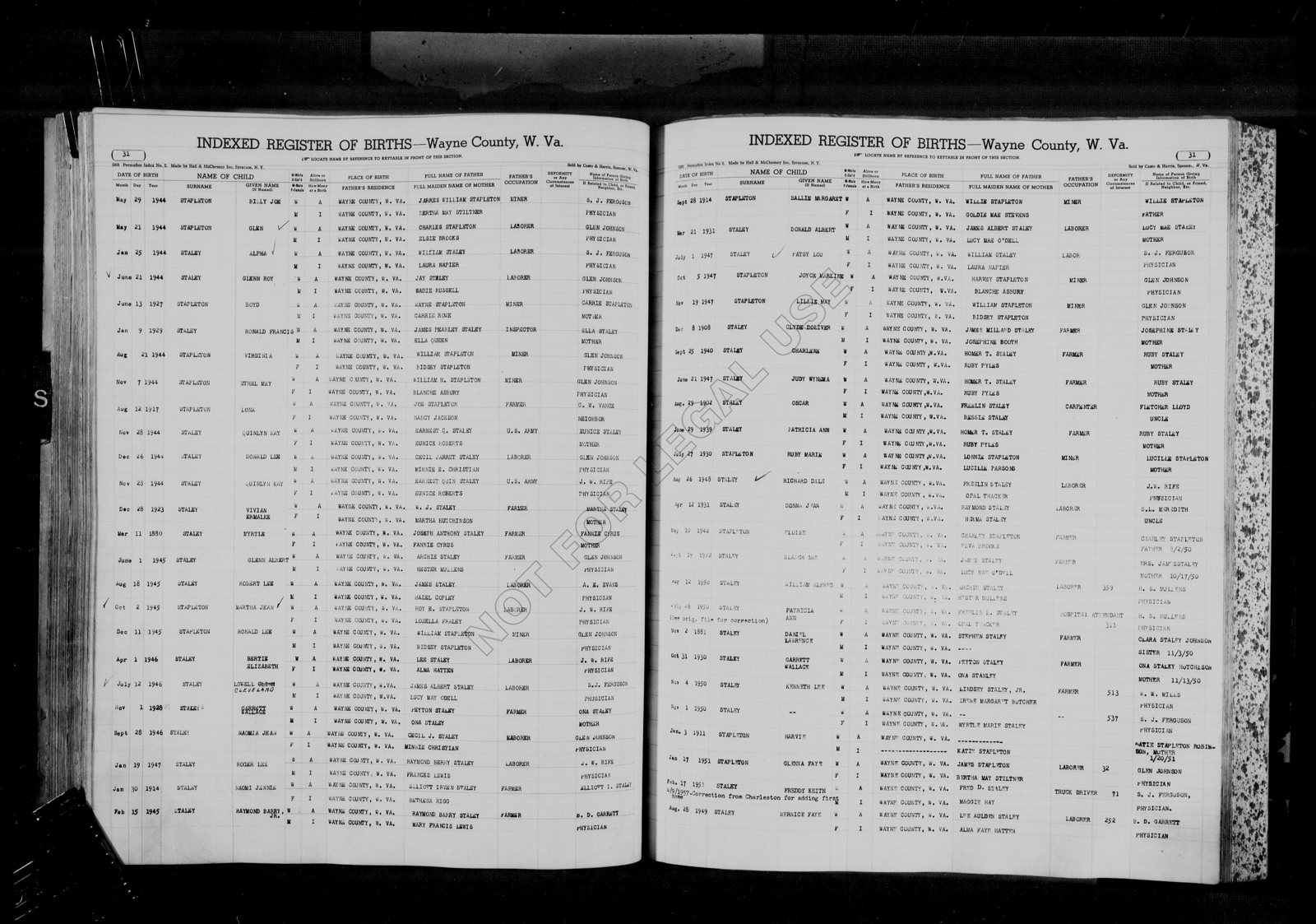
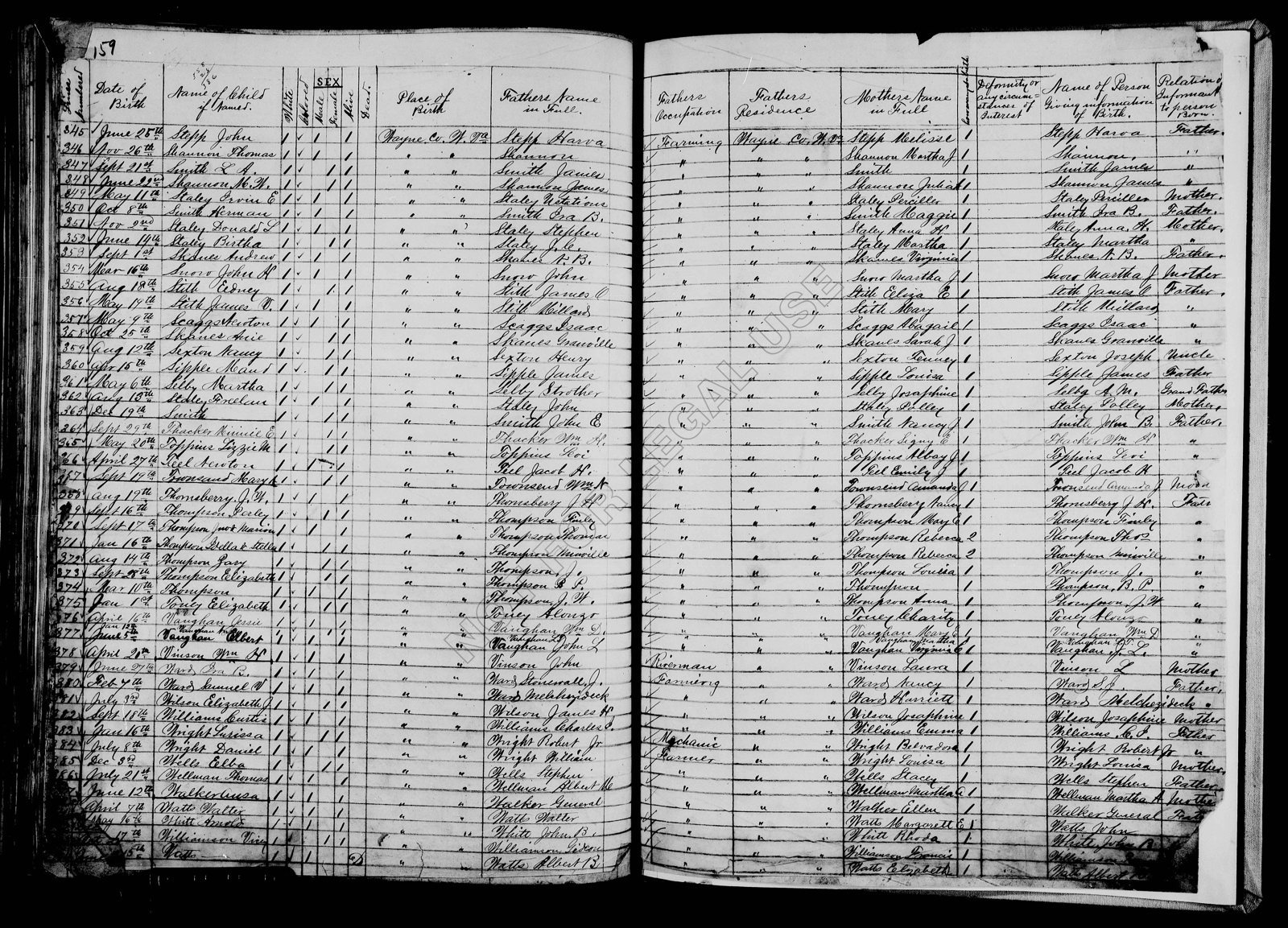
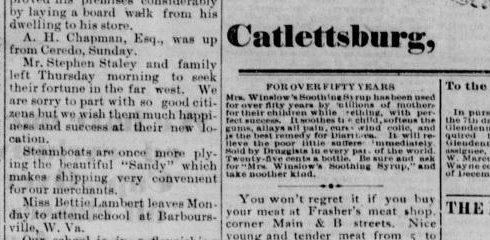
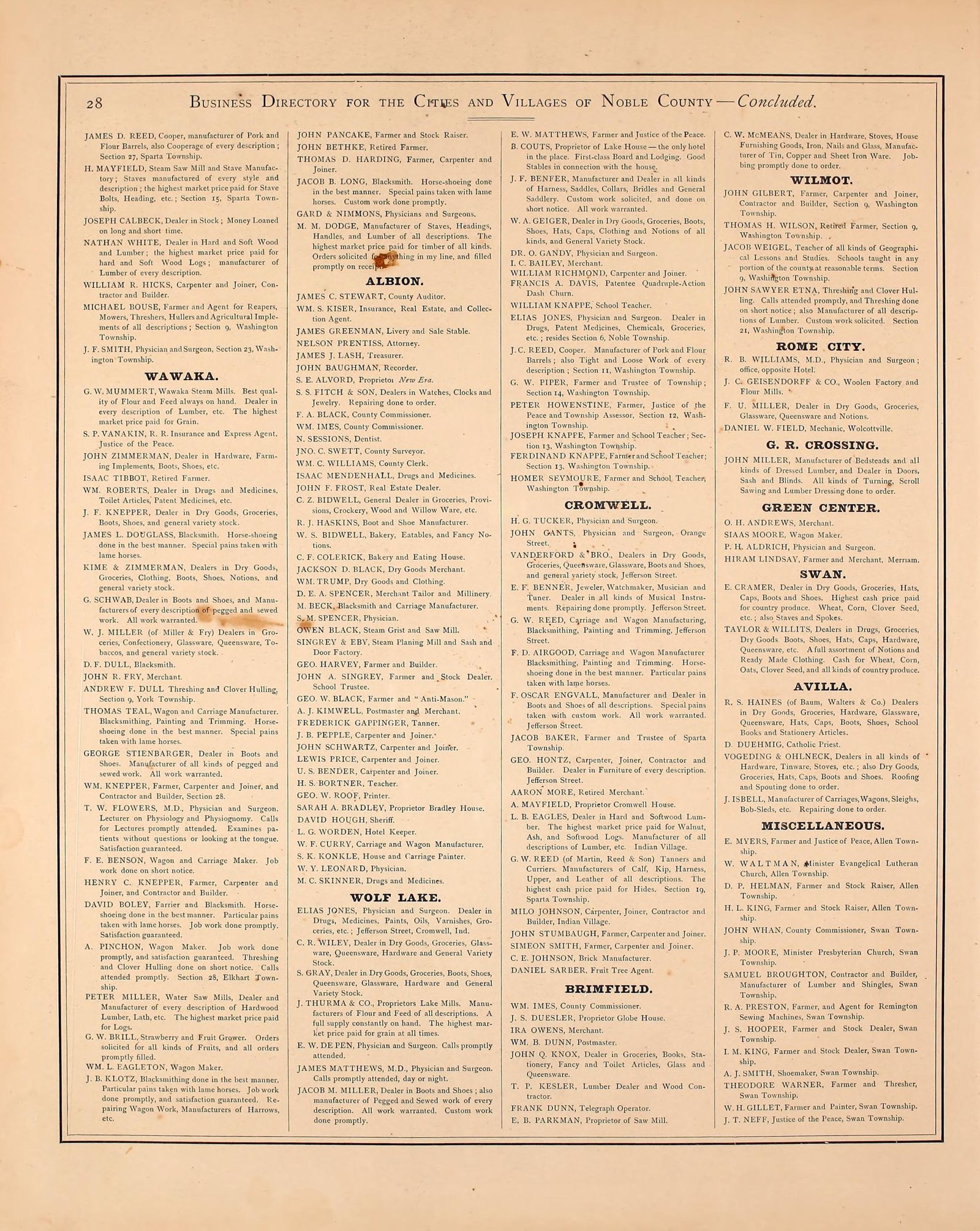
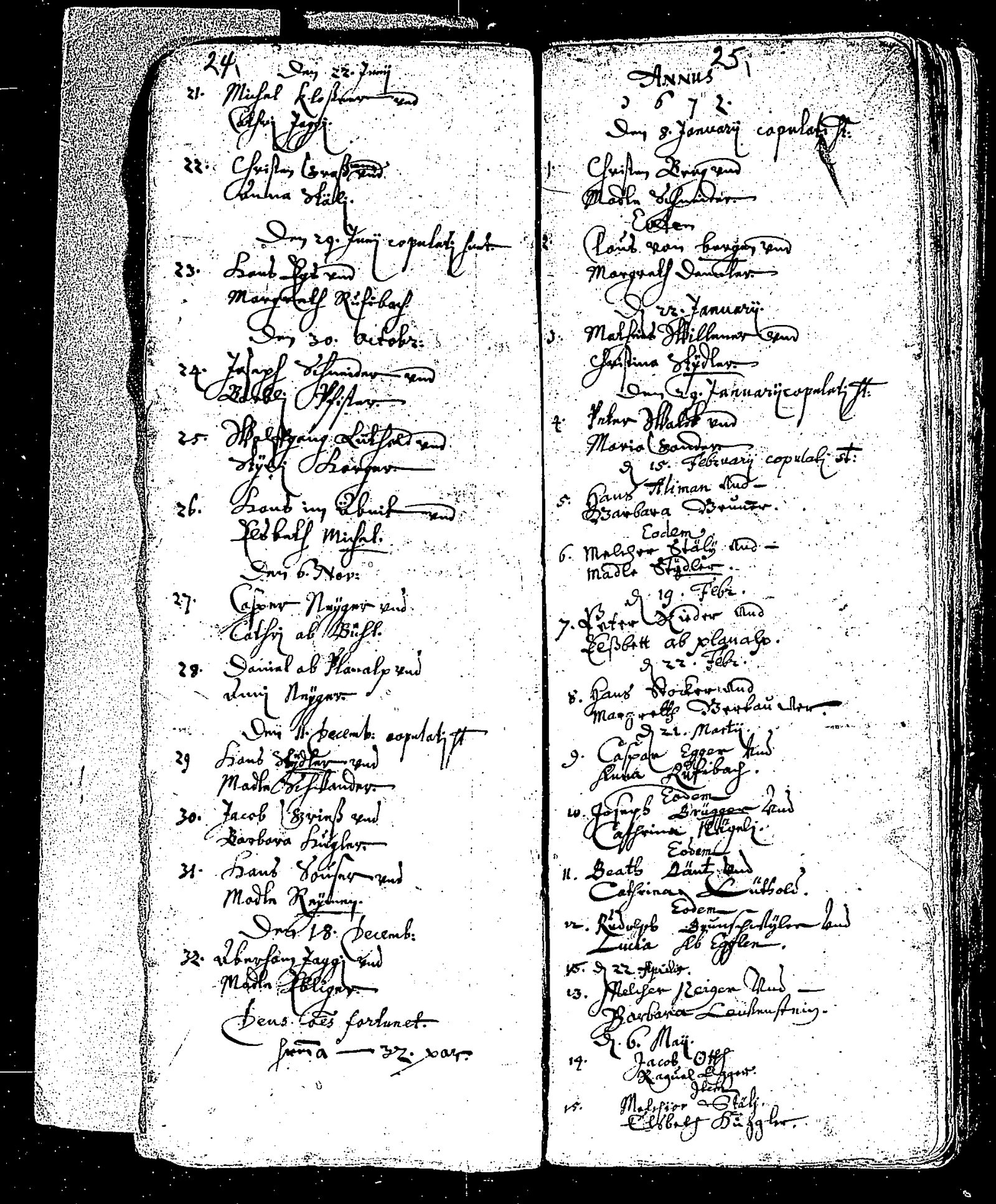
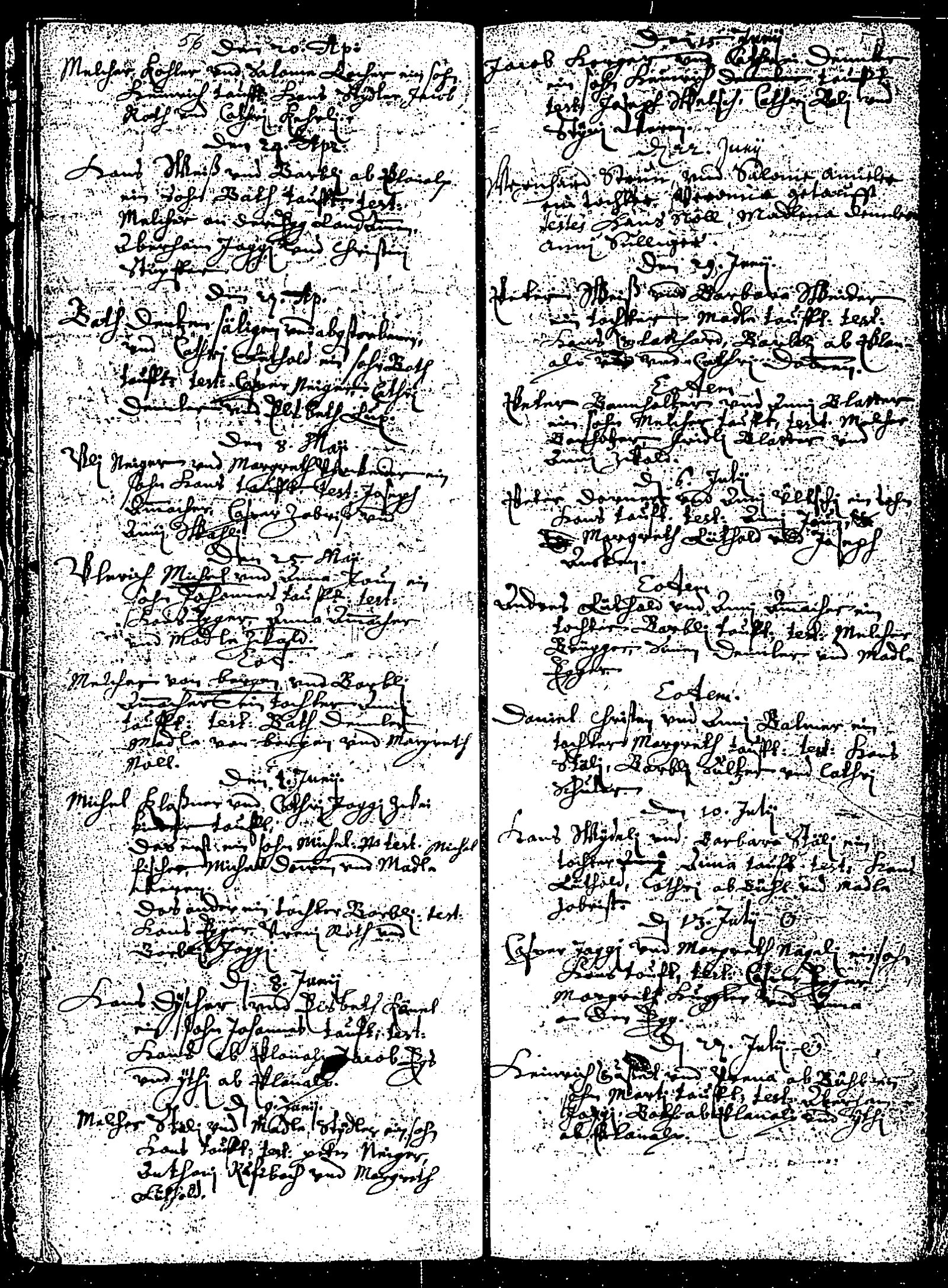
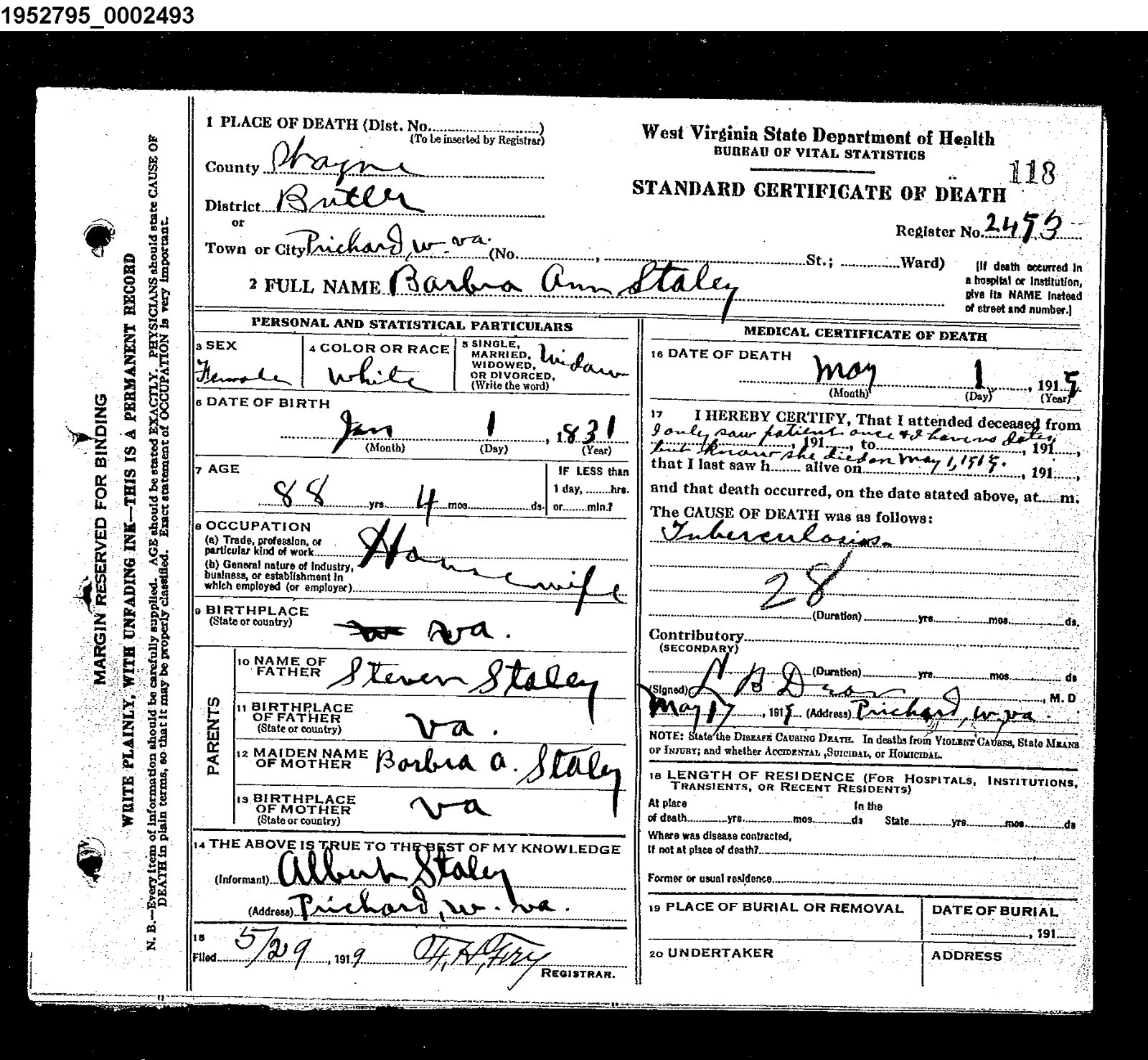
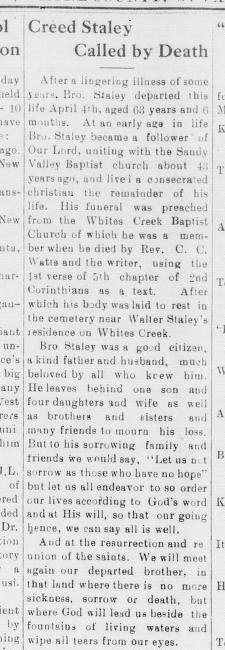
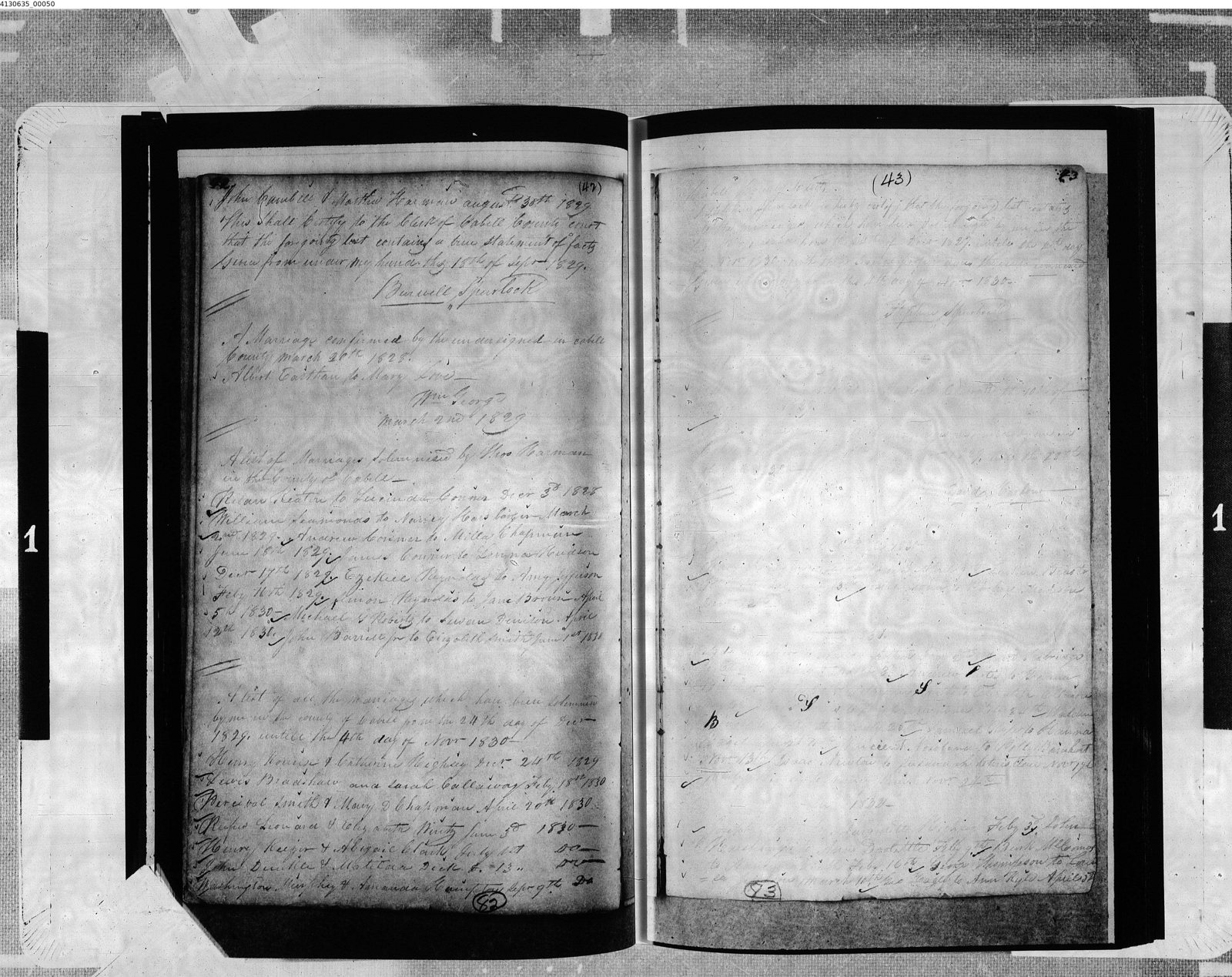
EVIDENCE
Evidence list and method
Every citation in the text points to an entry below. Each entry describes the record, says how far it reaches, and is backed by preserved copies, transcripts and notes in the private research archive. Restricted images from subscription services, private correspondence and records naming living people are kept in that archive and not reproduced.
Labels used: proved; strong indirect evidence; identified but not closed (one direct but late or uncorroborated source); working hypothesis (our best guess, not yet supported enough to state as fact); conflict; negative control (a record that keeps the wrong person out); and open boundary (where the evidence currently stops).
E01 · Daniel Lawrence Staley indexed birth-register entry
The indexed Wayne County entry names Daniel Lawrence Staley and father Stephen Staley; it is one half of the paired-register proof of Daniel's parents.
West Virginia Archives and History, Vital Research Records, Wayne County indexed register of births, Daniel Lawrence Staley, 2 November 1881, image 583484/00395. Source link.
E02 · Donald L. Staley contemporaneous birth-register entry
The contemporary Wayne County register records Donald L. Staley on the same date and names Stephen and Anna H. Staley; the name conflict is resolved by correlation, not concealment.
West Virginia Archives and History, Vital Research Records, Wayne County birth register, Donald L. Staley, 2 November 1881, image 583485/00202. Source link.
E03 · Stephen Staley and Ann H. Gardner marriage
The Lawrence County marriage entry proves the marriage event; the contemporary newspaper notice independently reports the same couple and date.
Lawrence County, Ohio, marriage-book entry 269, Stephen Staley and Ann H. Gardner, 5 June 1853; corroborated by Spirit of the Times (Ironton), 14 June 1853, page 3. Source link.
E04 · Stephen and Mary Staley household in Wayne County
The 1850 household places a younger Stephen with Stephen and Mary Staley, but the schedule supplies no relationship column.
1850 U.S. census, Wayne County, Virginia, District 66, dwelling 298, family 314, Stephen Staley household.
E05 · Stephen and Ann Staley household in Lawrence County
The 1860 household continues the married couple after the 1853 ceremony and begins the child cluster used for later identity correlation.
1860 U.S. census, Rome Township, Lawrence County, Ohio, Stephen Staley household.
E06 · Stephen and Ann Staley household in Ceredo
The 1870 record places the couple and their children back in Wayne County and supports the Ohio-to-West Virginia movement.
1870 U.S. census, Ceredo, Wayne County, West Virginia, Stephen Staley household.
E07 · Stephen Story/Storey household variant
Wife, children, ages, and place show that the Story/Storey household is the same family despite the surname spelling.
1880 U.S. census, Butler District, Wayne County, West Virginia, Stephen Story/Storey household.
E08 · The family leaves for the far west
The White's Creek column reports that Stephen Staley and family left to seek their fortune in the far west; correlation with the Arkansas endpoint makes this a migration marker, not a destination proof by itself.
The Ceredo Advance (Ceredo, West Virginia), 16 December 1891, page 5, White's Creek column. Source link.
E09 · Stephen Staley's Arkansas endpoint
A Jonesboro newspaper funeral notice, a granddaughter network, and Pine Log cemetery evidence place the elder Stephen in Craighead County, Arkansas, at death.
The Sun (Jonesboro, Arkansas), 25 January 1906, page 3; Pine Log Cemetery survey and memorial controls.
E10 · Wayne County estate-share and partition network
The deeds and partition-party network strongly place Stephen S. within the child or heir-class of Stephen Staley Jr.'s family, but no inspected record directly calls him a son.
Wayne County, Virginia/West Virginia, estate-share and partition deeds for the lands of Stephen Staley deceased, 1856-1868.
E11 · Barbara Ann Staley death certificate
The certificate names father Steven Staley and mother Barbara A. Staley, a useful collateral clue that conflicts with simplified child lists and requires informant-quality caution.
West Virginia Department of Health, death certificate of Barbara Ann Staley, Wayne County, 1 May 1919, register 2473. Source link.
E12 · Creed Staley obituary
The obituary documents Creed Staley's local identity, church life, wife, son, and daughters; it illuminates the Wayne kin network without proving Stephen S.'s parentage.
The Wayne News (Wayne, West Virginia), 11 April 1918, page 1, 'Creed Staley Called by Death.' Source link.
E13 · Joseph Stailey and Margareth Highsey marriage control
The Cabell County marriage return establishes a real Joseph Stailey/Margareth Highsey pair and helps separate collateral households; it does not name Joseph's parents.
Cabell County, Virginia, marriage return for Joseph Stailey and Margareth Highsey, 24 December 1832, image 559887/00050. Source link.
E14 · Jacob Staley of Berkeley County will
Jacob's will names wife Catharine and sons Jacob, Peter, John, Stephen, and Daniel, plus daughters Sarah Fisher and Catherine Strayer; it proves son Stephen but not the testator's parents or European origin.
Berkeley County, Virginia, probate loose papers, will of Jacob Staley, dated 26 August 1793 and proved in 1793, images 353-354.
E15 · Peter Staley pension declaration W6194
Peter reported a 1754 Pennsylvania birth, York County service, and a York-to-Berkeley-to-Frederick-to-Berkeley/Jefferson residence sequence; the declaration does not identify Berkeley Jacob as the 1793 testator.
Revolutionary War pension file W6194, declaration of Peter Staley, Jefferson County, Virginia, 15 July 1833.
E16 · Daniel Staley testimony in W6194
Daniel certified that Peter Staley was his brother and Margaret was Peter's widow; the file also preserves the Peter/Margaret marriage-bond copy with Jacob Stayley as co-bound surety.
Revolutionary War pension file W6194, certification of Daniel Staley, 7 November 1839, and Berkeley County marriage-bond copy.
E17 · Barbara and Daniel Staley testimony in W6179
Barbara, widow of Jacob Staley, said her husband marched from York County and that they married at Shepherdstown. Daniel, aged 68, deposed that Jacob Staley was his father, that Jacob Jr. and Peter were his brothers, that his father and brother Jacob moved from Pennsylvania to Berkeley before Yorktown, and that Jacob Jr. was Barbara's husband. Read with the 1793 will, this strongly but indirectly supports a York County origin for the testator's family; it does not name Daniel's mother or the will.
Revolutionary War pension file W6179 (Jacob Staley, widow Barbara), declaration of Barbara Staley, Frederick County, Virginia, 26 October 1838, and deposition of Daniel Staley, Jefferson County, Virginia, 19 October 1838.
E18 · Separate Jacob Stealley estate in York County
York Deed Book 2B names Christoffel as eldest son and administrator of a deceased Jacob Stealley, John as heir and legatee, Joseph as legatee, and an unnamed widow; it proves a separate Germany Township estate cluster, not a Berkeley bridge.
York County, Pennsylvania, Deed Book 2B, pages 60-62, deed dated 22 January 1782 and recorded 11 June 1782.
E19 · Jacob and Elizabeth separated from Jacob and Catharine
The 1791 deeds make Jacob, husband of Elizabeth, a son of Peter Staley of Chanceford and a brother of Melchor, while the 1793 Berkeley will names the testator's wife as Catharine. On present evidence these are two different couples; a record naming the testator's wife as Catharine Elizabeth, or naming Peter as his father, would reopen the question.
York County deed copies, Deed Book 2G, pages 140 and 519; compared with the 1793 Berkeley County will of Jacob Staley.
E20 · Gundershoffen Stähli baptism entry 36
The original register resolves the date as 20 January 1732, not 30 January; a full paleographic transcription and any bridge to York or Berkeley remain open.
Evangelische Kirche Gundershofen, Kirchenbuch 1682-1791, baptisms, FamilySearch DGS 008319947, image 114 of 775, entry 36, Stähli, 20 January 1732; filmed at Archives départementales du Bas-Rhin.
E21 · Gundershoffen baptism of Jacob Stähli
The entry records Jacob, born 23 July and baptized 28 July 1709, to Jacob Stähli and Magdalena; it does not add Hans or Johann and does not give Magdalena's maiden surname.
Evangelische Kirche Gundershofen, baptism register, FamilySearch DGS 008319947, image 41 of 775, Jacob Stähli, 28 July 1709.
E22 · Meiringen marriage of Melcher Stäli and Madle Stydler
The official register records the couple at item 6 under the 15 February 1672 marriage heading; the event does not prove a later transnational identity chain.
Staatsarchiv des Kantons Bern, K Meiringen 19, marriage register 1664-1753, folio 25, item 6, 15 February 1672. Source link.
E23 · Meiringen baptism of Hans
The register reads a son Hans of Melcher Stäli and Madle Stydler under 9 June 1673; it does not record Johann Jakob or prove Hans was the later profile person.
Staatsarchiv des Kantons Bern, K Meiringen 6, baptism register 1668-1703, manuscript page 56, 9 June 1673. Source link.
E24 · Meiringen claimed Stähli-Huggler marriage
The complete 1695 page span was inspected, but no Stähli-Huggler couple could be read confidently. Difficult handwriting prevents treating that result as proof of absence.
Staatsarchiv des Kantons Bern, K Meiringen 19, marriage register, 1695 span, manuscript folios 66-67. Source link.
E25 · The Leni locator belongs to Brienz, not Meiringen
Exact event locators corrected the parish attribution from Meiringen to Brienz; the original image remains affiliate-center gated.
FamilySearch exact event locator for the 1700 Leni Stähli record, Brienz parish collection; original image access restricted to an affiliate center.
E26 · Floyd Earl Kenkel/Konkle birth record
The Michigan birth record names Edwin L. Kenkel and Ida M. Salesbury as Floyd's parents; later records control the spellings.
Michigan birth record for Floyd Earl Kenkel, Jackson, 9 June 1909, Michigan Birth Records 1867-1917.
E27 · Floyd Konkle marriage parent fields
Floyd's Michigan marriage record repeats Edwin L. Konkle and Ida Salisbury as his parents, independently reinforcing the birth record.
Michigan marriage record for Floyd Konkle and Josephine Campbell, 11 November 1927.
E28 · Edwin L. Konkle and Ida M. Salisbury marriage
The marriage record names Simon K. Konkle and Cornelia Andrews as Edwin's parents; census continuity connects the adult Edwin to their Indiana household.
Michigan county marriage record, Edwin L. Konkle and Ida M. Salisbury, Jackson, 24 May 1890.
E29 · Simon Konkle and Cornelia G. Andrews marriage
The Noble County marriage record proves the couple's marriage and anchors the household sequence that follows.
Indiana marriage record, Simon Konkle and Cornelia G. Andrews, Noble County, 17 March 1860.
E30 · Simon and Cornelia household continuity
Four censuses and the 1900 forty-year marriage statement hold Simon and Cornelia together in Albion across spelling and indexing variants.
U.S. censuses, Noble County, Indiana, Simon and Cornelia Konkle households, 1860, 1870, 1880, and 1900.
E31 · Simon Kenton Konkle death record
The death record names Christian G. Konkle and Mary Konkle as Simon's parents, but the late record lacks lifetime or near-lifetime corroboration.
Michigan death record for Simon Kenton Konkle, 1905, Michigan Death Records 1867-1952.
E32 · Simon Conkle in the Wildman household
Simon, age 14, appears with Stephen and Mary A. Wildman rather than with Christian and Mary; the schedule does not state relationships.
1850 U.S. census, York Township, Noble County, Indiana, Stephen and Mary A. Wildman household, including Simon Conkle.
E33 · Wayne County library negative and tax context
The library found no Konkle surname in the 1812-1851 will, estate, or guardianship index; 1826 tax material placed Mary Kinkler, Samuel Kinkler, and George Conkle in the county. The negative narrows a route but proves no absence from all records.
Wayne County Public Library, targeted will/estate/guardianship index review and 1826 tax-list extracts, July 2026.
E34 · S. K. Konkle, house and carriage painter
The Noble County atlas business directory lists S. K. Konkle in Albion as a house and carriage painter; it identifies work and place, not parents.
Historical Atlas of Noble County, Indiana (1874), business directory, Albion, page 28, entry for S. K. Konkle. Source link.
E35 · Allan Heath Cash parent-field record
A Virginia marriage record names Allan Heath Cash and Aileen Kendall Biggerstaff as the parents of Allan Heath Cash Jr.; living descendants are omitted from the public narrative.
Virginia Department of Health marriage record for Allan Heath Cash, certificate 1963040133.
E36 · Allan Cash in John W. and Nannie Cash household
The 1920 and 1930 censuses both identify Allen/Allan H. Cash as a son of John W. and Nannie L. Cash.
1920 and 1930 U.S. censuses, Spartanburg County, South Carolina, John W. and Nannie L. Cash household.
E37 · John Cash as son of Henry Cash
The relationship column directly identifies John, age 8, as Henry Cash's son.
1880 U.S. census, Spartanburg County, South Carolina, Henry Cash household, John Cash, relation son.
E38 · Henry Cash with Sidney/Cidey and Mary Cash
Henry appears in the same household sequence with Cidey/Sidney and Mary in 1850 and 1860, but neither census states relationships.
1850 and 1860 U.S. censuses, Spartanburg County, South Carolina, Cidey/Sidney and Mary Cash households.
E39 · Adult Henry Cash identity and probate lead
The 1870 Henry/Ceany household leads into the 1880 family; an 1897 administration-bond record points to probate but has not yielded an heir statement.
1870 U.S. census, White Plains, Spartanburg County, Henry and Ceany Cash; South Carolina administration-bond record for Henry Cash, 4 November 1897.
E40 · Ellen Kaye Turnes and Clarence Elwood Turnes parent fields
Ellen's marriage record names Clarence Elwood Turnes and Alma Virginia Williams; Clarence's marriage record names Wirt Henry Turnes and Rosa B. Bryant. The public account starts with these deceased anchors.
Virginia marriage records for Ellen Kaye Turnes, 1963, and Clarence Elwood Turnes, 1936.
E41 · Wirt/Wert Turnes to Henry and Louisa
The 1902 marriage register names Henry C. Turner as Wirt/Wert's parent; the 1880 census identifies Henry and Louisa as his father and mother. Spouse, place, age, and household control the spelling variants.
Appomattox County marriage register, Wert H. Turner and Rosa B. Bryant, 1902; 1880 U.S. census, Charlotte County, Virginia, Rosser/Turns household.
E42 · Henry C. Turnes names Aaron Turnes as parent
Henry's Appomattox marriage register directly names Aaron Turnes as a parent; it does not name Henry's mother or Aaron's parents.
Appomattox County, Virginia, marriage register, Henry C. Turnes and Isabel Beasley, 13 January 1908.
E43 · Henry in Aron and Mary Turnes household
Henry, age 5, appears with Aron, Mary, Pleasant, Samuel, and Alfred; the schedule does not state family relationships.
1850 U.S. census, Campbell County, Virginia, Aron and Mary Turnes household.
E44 · Pleasant Turns names Aaron and Mary as parents
Pleasant's marriage row directly names Aaron and Mary; his shared 1850 household and military company with Henry strengthen the sibling cluster but do not directly name Henry's mother.
Appomattox County burned-years marriage compilation, Pleasant A. Turns and Mary F. Bagby, 22 December 1864.
E45 · Henry Clay Turnes service chronology
The service record places enlistment after the Battle of Kelly's Ford, later marks Henry sick or hospitalized, and ends with Appomattox parole; it contains no Kelly's Ford wound card.
Compiled service record of Henry C. Tornes/Turnes, Company H, 2nd Virginia Cavalry, enlistment 25 September 1863 through Appomattox parole, 9 April 1865.
E46 · Henry and Pleasant on the Appomattox parole list
The National Park Service list places Henry Clay Turnes and Pleasant Andrew Turnes in Company H, 2nd Virginia Cavalry; shared service supports the cluster but does not prove kinship alone.
National Park Service, Appomattox Court House, list of paroled soldiers, Henry Clay Turnes and Pleasant Andrew Turnes, Company H, 2nd Virginia Cavalry.
E47 · Library of Virginia response
The reply defined access and paid-search routes but supplied no record image, index hit, or relationship evidence; it changed the process, not the family conclusion.
Library of Virginia Archives Reference Services response concerning Campbell County Turnes tax and county-record research, July 2026.
E48 · Peter Staley heirs sell Chanceford land
A power of attorney of 15 January 1791 by Jacob Staley and wife Elizabeth, Sarah Staley the younger and Sarah Staley the widow, all of Berkeley County, and a deed of 9 December 1791 by Melchor and Peter Stailey of Berkeley County, state that Peter Stailey of Chanceford died intestate leaving Jacob, Melchor, Peter, Sarah the younger and the widow Sarah, and call Melchor their brother.
York County, Pennsylvania, Deed Book 2G, pages 140-141 (power of attorney acknowledged at Shepherdstown, 15 January 1791) and pages 519-521 (deed, 9 December 1791); copies supplied by the York County History Center, October 2026.
E49 · Jacob Staley and Elizabeth Goering (court abstract)
Cannon's 1948 report abstracts a York Orphans' Court docket entry of 27 March 1781 stating that Jacob Staley married Elizabeth, daughter of Jacob Goering of Chanceford Township and sister of the Reverend Jacob Goering. The original docket page has not been inspected. The Reverend Jacob Goering was born in 1755 to Jacob and Margaret Goering.
Edith Beard Cannon, 'Evidences of the Stehly Families of York County Before the Year 1850,' Genealogical Reports for the Historical Society of York County, no. 19 (1948), p. 29, citing York County Orphans' Court Dockets D, p. 212; Frederick Lewis Weis, The Colonial Clergy of the Middle Colonies, for the Goering birth.
E50 · St. Luke's (Stehli's) Union Church register, Chanceford
Cannon's transcription records Jacob and Elisabeth Stehly's children Peter (1779, sponsors Jacob and Margaret Goering), Jacob (1780) and Margaret (1784); Stephan and Margreth Stehly's sons Stephen (1781) and Melchior (1785); communicants Ana Ewa Stehli, widow (1775), and Salome, wife of Peter Stehli, deceased (1782); and 1772 church-building pledges by Jacob, Andreas and Peter Stehly.
Register of Stehli's (later St. Luke's) Union Congregation, Chanceford Township, 1773-1835, as translated by Edith Beard Cannon, in Cannon, Stehly Report (1948), pp. 10-12.
E51 · Original Chanceford surveys: Icy Hill and the church lot
A survey of 12 January 1769 lays out 183 acres called Icy Hill for Jacob Stealy Senior, with Jacob Stealy Junior adjoining. A survey of 8 December 1772 lays off 1 acre 126 perches for the Lutheran and Reformed congregations as part of a tract belonging to Stephen Stealy, by his direction.
Pennsylvania land surveys, York County series, York-9310 (12 January 1769) and York-9271 (8 December 1772), copies supplied by the York County History Center; context from Neal Otto Hively, The Chanceford Townships, Original Pennsylvania Land Records vol. 8.
E52 · Jacob and Catharina in Hellam and York Townships
Transcripts record Johannes, son of Jacob and Catharina Stäheli, baptized at Kreutz Creek Reformed Church, Hellam, 5 September 1764; Jacob and Catharina as baptism sponsors there in 1764 and 1766, with Peter and Salome Ställy sponsoring on the same day in 1766; and Daniel, son of Jacob Steli or Staehle, born 1770, at Blymire's church in York Township. These are the best current candidates for the testator's household. Original registers not yet seen.
Cannon, Stehly Report (1948), pp. 13, 15-16 and 29 (Calendar of Vital Records, source 299; Kreutz Creek Reformed register items 41, 60, 61); Genealogical Reports of George R. Prowell, Aimee Devine Sanders and Martha B. Lee, vol. I, p. 80, Historical Society of York County.
E53 · Chanceford estate, tax and militia controls
A Jacob Staley of York County, yeoman, was dead by 30 June 1772 (administrators Eva and Jacob). Peter Staley was in Hellam in 1767 and 1772, on a Chanceford militia return of 26 April 1778, and dead by 8 May 1778 (administrators Sarah and Jacob); his sons Michael (15 in 1779) and Peter (14 in 1782) chose guardians. The 1783 tax lists Jacob Steally (150 acres) and Stephan Stealy (30 acres) in Chanceford.
York County administration bonds C:110 (1772) and D:128 (1778); Orphans' Court dockets D:135 (1779) and E:7 (1782); 1783 tax record cards; York Deed C:355 (1767); Pennsylvania Archives militia returns; as abstracted in Cannon, Stehly Report (1948), and YCHC record cards.
E54 · Hans Jacob Ställy arrives at Philadelphia
A Hans Jacob Ställy took the oaths at Philadelphia on 30 August 1749 after arriving on the ship Crown. Nothing yet connects him to Hellam, to Catharina, or to Berkeley County.
Ralph Beaver Strassburger and William John Hinke, Pennsylvania German Pioneers, vol. 1, as cited in Cannon, Stehly Report (1948), p. 28.
E55 · Edmond Earl Staley birth record
An Arkansas birth record names Edmond Earl Staley, born 25 November 1911 at Lake City, Craighead County, with parents Daniel Lawrence Staley and Nellie Novella Tiner. Some later records give October as the birth month.
Arkansas birth record of Edmond Earl Staley, 25 November 1911, Lake City, Craighead County.
E56 · Edmond Earl in Daniel Lawrence Staley household
The 1920 census lists Edmond E., age 8, with Lawrence D. and Wellie N. Staley in Maumell, Craighead County; the 1930 census lists Earl E., age 18, with Daniel L. and Nellie N. Staley in Richwoods, Jackson County, Arkansas.
U.S. census, 1920, Maumell Township, Craighead County, Arkansas; 1930, Richwoods Township, Jackson County, Arkansas.
E57 · Edmon Earl Staley draft registration at Dyess
Edmon Earl Staley registered on 16 October 1940 giving R.F.D. No. 1, Dyess, Arkansas, as his address and 'Self' as employer. The card does not show a numbered colony farm or an employer.
Selective Service registration card of Edmon Earl Staley, 16 October 1940, National Archives Record Group 147.
E58 · Brother Earl Staley at Dyess
A church paper reports a Dyess congregation led by Brother Earl Staley. The name and place fit Edmond Earl, but there is no second identifier.
The Pentecostal Gleaner, March 1943, p. 7.
E59 · Edmond and Mary Staley in Marshall, Michigan
The 1950 census lists Edmond E. and Mary Staley in Marshall, Calhoun County, Michigan, with Edmond working as a press operator in sheet-metal manufacturing. Living household members are not named here.
U.S. census, 1950, Marshall, Calhoun County, Michigan, enumeration district 13-130, sheet 17, National Archives.
E60 · Mary Jane (Jackson) Staley obituary
Mary Jane Staley (28 August 1914 to 11 August 2014), born in Poinsett County, Arkansas, married Edmond Earl Staley on 16 October 1931 (an Arkansas license image is dated 15 October 1932), came to Michigan in 1949, settled in Marshall in 1950, moved to Albion in 1962, retired from Albion College, and was buried at Albion Memory Gardens.
Obituary of Mary Jane Staley, J. Kevin Tidd Funeral Home, Albion, Michigan, 2014; Arkansas marriage license of Edmond Earl Staley and Mary Jane Jackson.
E61 · Daniel L. Staley obituary
Daniel L. Staley, 90, died at Albion in April 1972. The obituary gives his birth on 2 November 1881 at Huntington, West Virginia, as a son of Stephen and Polly Ann (Gardner) Staley; his 1905 marriage to Novella A. Tiner at Lake City, Arkansas; his move to Albion from Little Rock in 1945; work at Lonergan Mfg. Co. and as custodian at 'Decker Nut Mfg. Co.'; Assembly of God membership; a son Edmond Earl of Albion; and burial at Albion Memory Gardens.
Obituary of Daniel L. Staley, Battle Creek Enquirer, 10 April 1972; copy supplied by Albion District Library.
E62 · Edmond Earl Staley death and burial
Michigan and Social Security death indexes and the cemetery record place Edmond Earl Staley's death in November 1986 at Albion and his burial at Albion Memory Gardens.
Michigan Death Index; Social Security Death Index; Albion Memory Gardens burial record.
E63 · Decker Screw Products, Albion
Decker's company history names Victor Decker, Walter Konkle and Eric Biewend as the 1927 founders of Decker Screw Products in Albion; U.S. Patent 2,090,960 (filed 1934, granted 1937) names Walter R. Konkle of Albion as inventor of a caster assigned to the company. No kinship to the family in this history is claimed.
Decker Manufacturing Corp., company history page; U.S. Patent 2,090,960, 'Caster,' granted 24 August 1937.
E64 · Floyd Konkle employed at Decker Screw Products
Floyd Konkle's 16 October 1940 draft registration at Albion, Michigan, names Decker Screw Products Co. as his employer. It does not show any family connection to the company's founders.
Selective Service registration card of Floyd Konkle, Albion, Michigan, 16 October 1940, National Archives Record Group 147.
E65 · Dyess Colony history
Dyess was a federal farm colony begun in 1934 in Mississippi County, Arkansas, planned for about 500 white farm families; Johnny Cash grew up on its Farm No. 266; the colony was flooded in January 1937, ten years after the Great Flood of 1927. Context only, not family evidence.
Encyclopedia of Arkansas, 'Dyess (Mississippi County)'; Arkansas State University, Dyess Colony Redevelopment Master Plan (2010); Fred Carl Smith, Shadows Over Goshen (2008); National Park Service, Farm No. 266. See also Cotton Country to Calhoun County: Dyess, Albion and Marshall, https://news.rvacyber.com/briefings/dyess-albion-marshall/.
E66 · Dyess Colony housing lead
The Historic Dyess Colony archivist reported finding housing information for two Staley households, D. L. and Novella, and Earl and Mary. The underlying records and plot numbers have not yet been received or inspected.
Correspondence with Historic Dyess Colony archives, September 2026 (private research file).